 NBCNGMI™
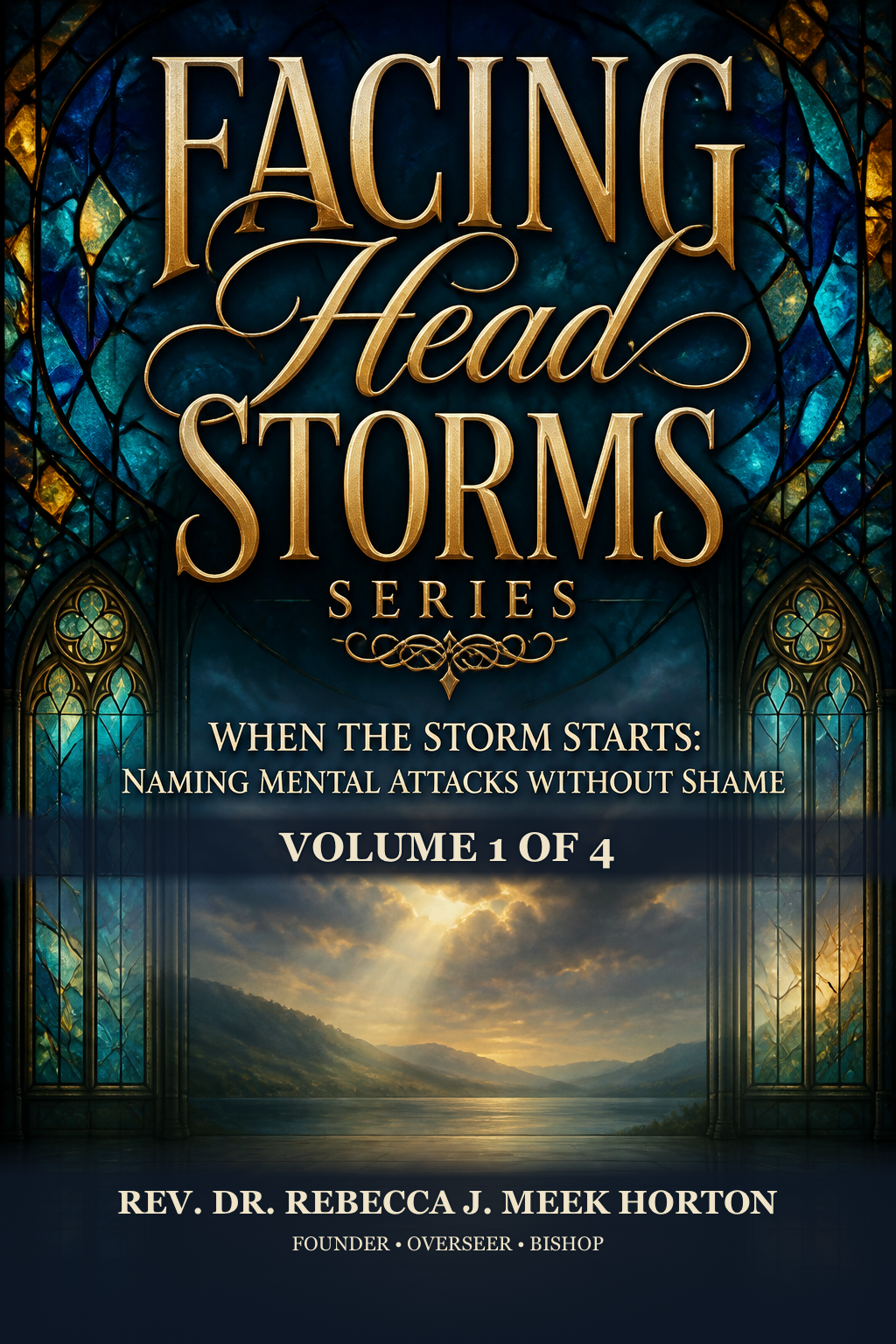
Facing Head Storms · Volume 1
When the Storm Starts: Naming Mental Attacks Without Shame
Part 1 of 4 in the series "Facing Head Storms". Series theme: Ways to facehead storms Series arc: This four-book series moves from recognition to renewal, from renewal to support, and from support to stewardship. The first book helps readers name mental attacks without shame or confusion. The second
Chapter 1 preview
NBCNGMI MASTER KNOWLEDGE LIBRARY Featuring the works of The Sage, Apostle Prophet. Rev. Dr. Rebecca J. Meek Horton, Apostolic Prophetic Architect, NewBeing Creation Network Global Ministries, Inc. Integrated Framework Modalities™
Chapter 1 — The Storm Has a Name
She sat in the church parking lot with both hands on the steering wheel, trying to breathe before walking inside.
Nothing terrible had happened that morning. No argument. No emergency. No visible crisis.
But inside her mind, a storm was moving.
One thought kept circling: You are failing everyone.
Then another: God must be disappointed in you.
Then another: What if this never gets better?
By the time she opened the car door, she was not only tired from the thoughts. She was ashamed that the thoughts were there.
That shame made the storm heavier.
Many people suffer twice. First, they suffer the mental attack itself. Then they suffer the shame of not knowing how to name it.
The controlling idea of this chapter is simple: a storm loses some of its power when it is named truthfully before God without shame.
Naming is not the same as explaining everything. Naming is not diagnosing yourself. Naming is not pretending every struggle has one cause. Naming is the first faithful act of clarity. It says, “Something is happening in my mind, and I will bring it into the light.”
The Mind Can Become a Battleground
The Bible does not treat the inner life as small.
Thoughts matter. Imaginations matter. Desires matter. Fear matters. The unseen life shapes the lived life.
This is why Scripture speaks seriously about the mind.
2 Corinthians 10:4-5 (KJV)
For the weapons of our warfare are not carnal, but mighty through God to the pulling down of strong holds;) Casting down imaginations, and every high thing that exalteth itself against the knowledge of God, and bringing into captivity every thought to the obedience of Christ;
Paul does not say every thought should be ignored. He says thoughts can be brought into captivity to the obedience of Christ.
That means some thoughts are not neutral.
Some thoughts accuse. Some tempt. Some frighten. Some confuse. Some repeat until they feel stronger than truth. Some rise suddenly and disturb the heart. Some sound like your own voice but carry the weight of a lie.
This book uses the phrase mental attacks to describe those inward pressures that strike the mind and spirit with intrusive thoughts, accusation, fear loops, despair, confusion, temptation, or spiritual pressure.
That phrase is not meant to replace medical language. It is not meant to label every emotion as spiritual warfare. It is not meant to make people afraid of their own minds.
It is a faithful way to say, “There are times when thoughts come against truth, peace, wisdom, obedience, and hope.”
A student may sit in class and suddenly think, I will never be able to do this. A parent may lie awake and replay every possible danger that could touch a child. A minister may finish preaching and immediately hear, You are a fraud. An educator may carry the weight of a classroom and think, Nothing I do matters. A young adult may be tempted by a thought they hate and then feel dirty because it crossed their mind.
The storm does not always announce itself with noise. Sometimes it whispers. Sometimes it repeats. Sometimes it disguises itself as wisdom, caution, humility, or realism.
But fruit reveals much.
If a thought drives you toward God with honesty, repentance, courage, and wise action, it may be part of conviction or discernment.
If a thought drives you toward shame, hiding, panic, despair, secrecy, isolation, or self-destruction, it needs to be named and brought into the light quickly.
This chapter is not asking you to solve the whole storm today.
It is asking you to stop calling the storm “me.”
Naming Without Shame
Shame says, “If I were stronger, I would not think this.”
Wisdom says, “A thought is present. I need to name it honestly and respond faithfully.”
Those two sentences lead to very different places.
Shame pushes people into hiding. It makes a person afraid to pray honestly, afraid to ask for help, afraid to tell a trusted person what is happening. Shame often adds spiritual accusation to mental pressure: If you really loved God, your mind would not be like this.
That is not how Jesus treats the burdened.
Matthew 11:28 (KJV)
Come unto me, all ye that labour and are heavy laden, and I will give you rest.
Jesus does not invite only the calm. He invites the heavy laden.
Mental heaviness is real heaviness. A person can be tired in the body and also tired in the mind. A person can love God and still feel attacked by fear. A person can be saved and still need help learning how to steward thoughts. A person can pray and still need counsel, rest, support, or appropriate care.
Naming without shame sounds like this:
This is an intrusive thought.
This is an accusing thought.
This is a fear loop.
This is despair speaking in absolutes.
This is confusion pressing me to rush.
This is temptation trying to pull me toward compromise.
This is spiritual pressure, and I need to stand in truth.
These statements are not excuses. They are clarifying sentences.
RE-Language™ helps here. Instead of saying, “I am crazy,” say, “I am experiencing mental pressure, and I need wisdom and support.”
Instead of saying, “I am weak,” say, “I am under strain, and I need to respond with truth.”
Instead of saying, “God must be angry with me,” say, “I need to bring this thought before God and test it by Scripture.”
A teacher once noticed a student who kept putting his head down during math. At first, it looked like laziness. But when she asked gently, he said, “Every time I try, my mind says I’m stupid.”
That sentence changed the room.
The teacher could now respond to what was actually happening. The issue was not only math. It was an inner message attacking the student’s courage.
Naming did not solve everything that day. But it opened the right door.
That is what naming can do.
It opens the right door.
If you cannot name the storm, you may fight the wrong thing. You may fight your personality when you need to confront a lie. You may fight your family when you need rest. You may fight God when you need to pour out your heart. You may fight yourself when you need help.
Psalm 62:8 (KJV)
Trust in him at all times; ye people, pour out your heart before him: God is a refuge for us. Selah.
Pouring out your heart is not the same as being ruled by every feeling. It is bringing the real thing before the real God.
That is a mature act.
The Storm May Have More Than One Factor
One of the most important truths in this book is this: not every mental attack has one simple cause.
This must be said plainly.
Some storms are connected to spiritual pressure. Some are connected to exhaustion. Some are connected to trauma. Some are connected to grief. Some are connected to medical conditions. Some are connected to sin patterns. Some are connected to relational stress. Some are connected to lack of sleep, poor nourishment, isolation, or overload. Some are connected to demonic accusation or temptation. Many are a mixture.
Wisdom refuses shallow explanations.
James 1:5 (KJV)
If any of you lack wisdom, let him ask of God, that giveth to all men liberally, and upbraideth not; and it shall be given him.
Notice the mercy in this verse. God gives wisdom. He does not shame the one who asks.
That matters when the storm is confusing.
A parent may say, “My child is just being rebellious,” when the child is actually overwhelmed, anxious, and afraid to disappoint the family.
A minister may say, “I just need to pray harder,” when the body is exhausted from years of carrying crisis without rest.
A student may say, “Something is wrong with me,” when repeated stress, lack of sleep, and fear of failure are feeding a storm.
An educator may say, “I should be able to handle this,” when the weight of compassion fatigue is real.
A believer may say, “This is only spiritual warfare,” and ignore the need for counseling, medical evaluation, rest, or accountability.
Another believer may say, “This is only mental health,” and ignore prayer, Scripture, repentance, spiritual counsel, and obedience.
Both can become incomplete.
Faithful discernment asks better questions.
What is happening in my mind?
What is happening in my body?
What has been happening in my relationships?
What have I been carrying too long alone?
Is there sin I need to confess?
Is there a lie I keep agreeing with?
Is there fear I have allowed to interpret everything?
Is there trauma or grief that needs care?
Is there a medical or mental health concern that needs professional support?
Is there spiritual pressure that must be resisted with truth?
These questions are not meant to make you overthink. They are meant to slow down the rush to one easy answer.
A smoke alarm tells you something needs attention. But it does not tell you whether toast burned, a wire sparked, or a real fire has started in the wall. You still have to look carefully.
Mental storms are similar. The alarm matters. But wisdom looks carefully before deciding what kind of help is needed.
This is not weakness.
This is stewardship.
The First Work Is Recognition
The first work is not to win the whole battle in one moment.
The first work is recognition.
Before you can respond faithfully, you must see what is happening. Before you can bring a thought to truth, you must notice the thought. Before you can ask for help, you must admit that help may be needed. Before you can resist shame, you must hear the shame language clearly enough to reject it.
Recognition is not agreement.
If a thought says, You are worthless, recognizing the thought does not mean believing it. It means you can now separate the thought from truth long enough to respond.
If a thought says, Everyone would be better without you, that thought needs immediate support. Do not sit alone with it. Tell a trusted person, pastor, counselor, doctor, or crisis support service right away. Naming that kind of thought is not dramatic. It is responsible.
If a thought says, You should give up, recognition allows you to say, “Despair is speaking. I need truth and support.”
If a thought says, Hide this, recognition allows you to say, “Secrecy is part of the storm. I need to bring this into wise light.”
The goal is not to become suspicious of every thought. The goal is to become mature enough to notice when a thought is leading you away from truth, wisdom, life, and faithful action.
A man once described his mental storm like standing outside in heavy rain with no coat. He said, “I thought the rain was me. I did not know I could step back and say, ‘It is raining right now.’”
That sentence is simple, but it is powerful.
It is raining right now.
That means the weather is real, but it is not your identity.
A storm is happening, but it is not your name.
A thought is attacking, but it is not your lord.
A lie is loud, but it is not truth.
This is where the series begins. Not with pretending the storm is small. Not with panic. Not with shame. Not with one-size-fits-all answers.
We begin by telling the truth.
Something is happening in the mind.
God is not confused by it.
Wisdom is available.
Help is allowed.
Truth still stands.
The Cost of Naming
Naming the storm will cost you something.
It may cost you the comfort of denial. It may cost you the habit of pretending you are fine. It may cost you the pride of always being the strong one. It may cost you the secrecy that has protected shame. It may cost you the quick answer you wanted.
It may also require courage to say to someone safe, “I need help.”
For ministers, this can feel especially costly. People may expect you to always have language, strength, and answers. But shepherds are still sheep before the Chief Shepherd.
For parents, it may feel costly to admit that a child’s storm is not solved by correction alone. Love may require listening, boundaries, prayer, and support.
For students, it may feel costly to tell an adult, “My thoughts are scaring me.” But silence is not safety.
For educators, it may feel costly to recognize that what looks like behavior may be distress. Wisdom sees beyond the surface without excusing harm.
For believers, it may feel costly to hold together Scripture, prayer, counsel, medical wisdom, and daily responsibility. But truth is not threatened by wise care.
The cost is real.
But the cost of not naming the storm is often greater.
Unnamed storms grow in darkness. Named storms can be brought before God, examined with wisdom, and addressed with support.
That is why this first step matters.
Key Takeaways
• A mental attack can be named without shame.
• Not every storm has one simple cause.
• Recognition is the first faithful step toward wisdom and care.
Practice
Take five quiet minutes today.
Write one sentence that names what has been happening in your mind without attacking yourself.
Use this form:
I am noticing __________________________, and I am bringing it before God for wisdom, truth, and the next faithful step.
If what you are noticing includes thoughts of harming yourself or someone else, do not wait. Tell a trusted person immediately and seek urgent professional or crisis support. That is not failure. That is faithful stewardship of life.
This is the opening chapter. The complete publication is available in the full edition.
Back to the library