 NBCNGMI™
Hear the Play: Listening to the Whole Child
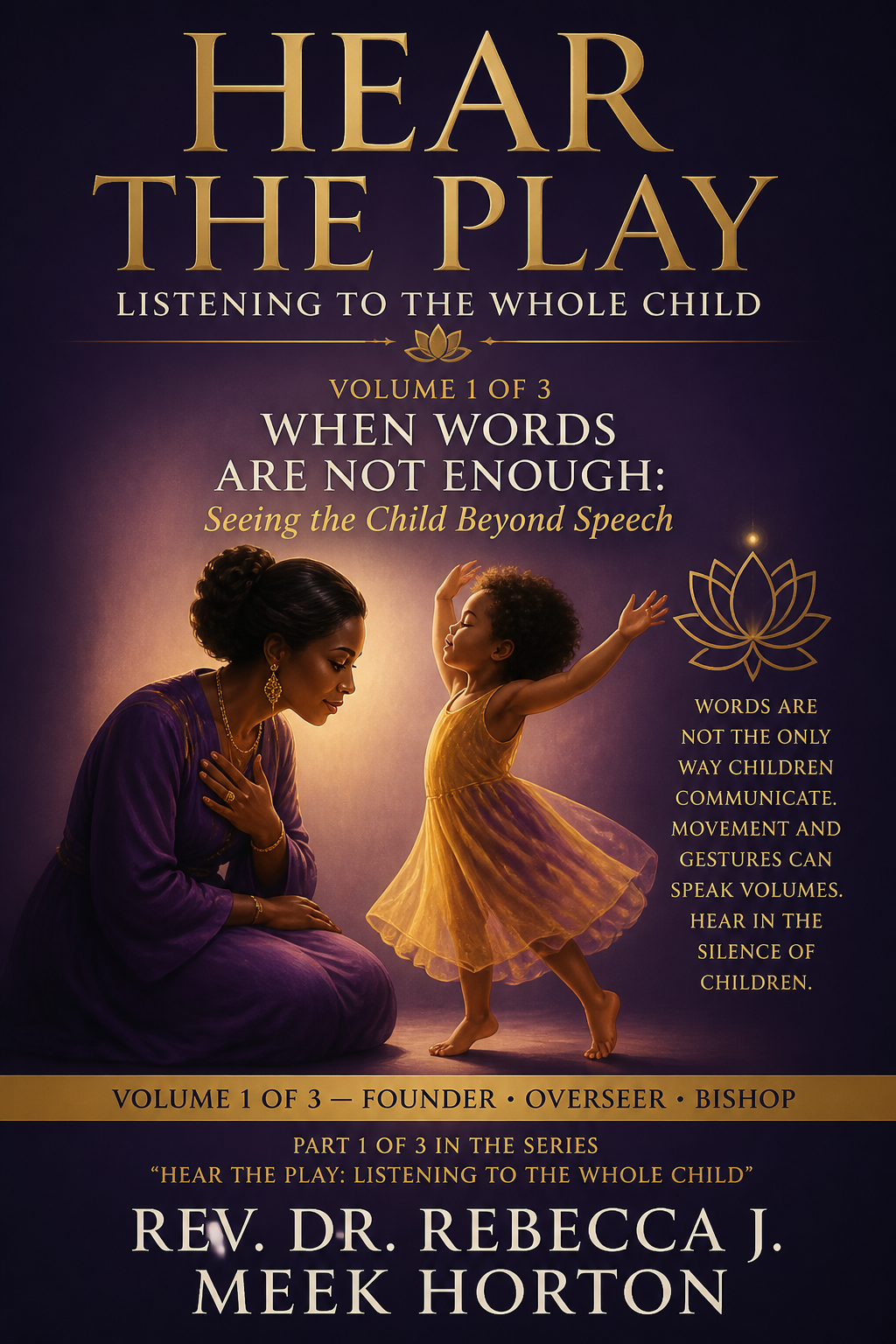
When Words Are Not Enough: Seeing the Child Beyond Speech — Its Companion Devotional/Journal
Companion Devotional/Journal
Chapter 1 preview
NBCNGMI MASTER KNOWLEDGE LIBRARY Featuring the works of The Sage, Apostle Prophet. Rev. Dr. Rebecca J. Meek Horton, Apostolic Prophetic Architect, NewBeing Creation Network Global Ministries, Inc. Integrated Framework Modalities™
Chapter 1 — The Child Is Speaking Before the Words Arrive
Entry 1
Scripture Reading
James 1:19 (KJV) Wherefore, my beloved brethren, let every man be swift to hear, slow to speak, slow to wrath:
Devotional
There are moments when a child’s silence feels like pressure. The clock is moving. The room is tense. The adult is trying to hold the schedule, the responsibility, the lesson, the family, the classroom, the ministry, or the day together. In that pressure, it is easy to demand words before the child has found them.
James gives us a holy order: swift to hear, slow to speak, slow to wrath. This is not only for arguments between adults. It belongs in the sacred work of caring for children. It teaches us that listening must come before interpretation, and interpretation must come before reaction.
A child may be speaking before the words arrive. The tight shoulders, the turned face, the refusal to move, the repeated question, the sudden cling, the hidden tears, the one shoe on and one shoe off: these may be early language. Not perfect language. Not language that removes boundaries. But language that asks to be received with wisdom.
Being swift to hear does not mean the adult becomes passive. It means the adult becomes present. We do not surrender our leadership; we purify it. We slow down enough to ask, What am I seeing? What am I assuming? What might this child be carrying that has not yet become words?
This kind of listening costs us. It interrupts our urgency. It confronts our need to be in control. It asks us to stay steady when the child is not yet steady. But this is part of mature love. The adult who listens first is not weak. The adult who listens first is wise.
Today, the invitation is simple but deep: hear before you hurry. A child does not need perfect adults. A child needs adults who are willing to notice, humble enough to pause, and faithful enough to guide without contempt.
There will still be shoes to put on. There will still be rooms to clean, lessons to finish, meals to serve, and limits to hold. But the spirit of the response can change. We can say, I see this is hard. I am here. We will take the next step together.
Sometimes the child is not refusing love. Sometimes the child is asking for help in a language still under construction.
Prayer
Father, I ask You to make me swift to hear today. Help me slow down before I label what I do not yet understand. Teach me to listen with my eyes, my heart, my posture, and my spirit, not only with my ears. When I feel rushed, help me not to let pressure become my master. When a child’s behavior stirs frustration in me, help me pause before anger speaks. Give me wisdom to guide with firmness and tenderness. Help me receive what is being communicated before I try to repair, correct, or explain. Make me a safe and steady presence. Amen.
Journal Prompt
James 1:19 calls me to be swift to hear. Where do I most often speak too quickly with a child, and what might change if I paused first?
Space to Write
[Answer Lines]
Entry 2
Scripture Reading
Proverbs 18:13 (KJV) He that answereth a matter before he heareth it, it is folly and shame unto him.
Devotional
Adults often answer children before we have truly heard them. We answer the posture. We answer the tone. We answer the interruption. We answer the refusal. We answer the inconvenience. But Proverbs warns us that answering before hearing is not wisdom. It is folly and shame.
This is a hard word because many of us have been trained to move quickly. We see a child put his head down and we answer with correction. We see a child refuse eye contact and we answer with pressure. We see a child cry at a small thing and we answer with dismissal. We see a child interrupt and we answer with irritation.
There may be correction needed. There may be a boundary to set. There may be a behavior that cannot continue. But the order matters. If we answer before we hear, even a correct instruction can land with the wrong spirit.
A child’s behavior is real, but our first interpretation may be incomplete. The head down may be laziness, but it may also be shame. The silence may be disrespect, but it may also be overwhelm. The refusal may be rebellion, but it may also be fear, fatigue, confusion, sensory distress, or a need the child cannot yet name.
Humility helps us say, I may not yet understand what I am seeing. That sentence can save a moment. It can save a relationship from unnecessary harshness. It can save a child from being named by a behavior instead of being seen as a person.
This does not mean we become afraid to lead. Children need adults who can guide them. They need structure. They need truth. They need correction that is clear and consistent. But they also need adults who do not mistake speed for wisdom.
The slower adult is not always the softer adult. Sometimes the slower adult is the stronger one, because it takes strength to hold back an answer until hearing has done its work.
Today, before you answer the matter, hear it. Notice the child’s body. Notice the movement. Notice the timing. Notice your own reaction. Ask God for wisdom before you speak into what you only partly understand.
A child may be giving you the beginning of the truth. Do not rush past the beginning because you want the conclusion.
Prayer
Father, I confess that I sometimes answer before I hear. I react to what is visible and miss what may be hidden beneath it. Help me become humble in my interpretations. Teach me to notice without rushing to judgment. When I need to correct, help me correct with understanding. When I need to set a limit, help me set it without shame or contempt. Give me discernment to separate behavior from identity. Help me hear the matter before I answer it, so my words become wise, steady, and life-giving. Amen.
Journal Prompt
Proverbs 18:13 warns against answering too soon. Think of one recent moment with a child. What did I assume, and what else might have been true?
Space to Write
[Answer Lines]
Entry 3
Scripture Reading
1 Samuel 1:12-16 (KJV) 12 And it came to pass, as she continued praying before the LORD, that Eli marked her mouth. 13 Now Hannah, she spake in her heart; only her lips moved, but her voice was not heard: therefore Eli thought she had been drunken. 14 And Eli said unto her, How long wilt thou be drunken? put away thy wine from thee. 15 And Hannah answered and said, No, my lord, I am a woman of a sorrowful spirit: I have drunk neither wine nor strong drink, but have poured out my soul before the LORD. 16 Count not thine handmaid for a daughter of Belial: for out of the abundance of my complaint and grief have I spoken hitherto.
Now Hannah, she spake in her heart; only her lips moved, but her voice was not heard: therefore Eli thought she had been drunken.
And Eli said unto her, How long wilt thou be drunken? put away thy wine from thee.
And Hannah answered and said, No, my lord, I am a woman of a sorrowful spirit: I have drunk neither wine nor strong drink, but have poured out my soul before the LORD.
Count not thine handmaid for a daughter of Belial: for out of the abundance of my complaint and grief have I spoken hitherto.
Devotional
Hannah was praying, but Eli misread her. Her lips moved. Her voice was not heard. From the outside, he saw something and made a conclusion. He thought disorder was in front of him, when sorrow was actually being poured out before the Lord.
This passage is a mercy to every adult who has ever misread a child. It reminds us that visible behavior does not always tell the whole story. Something can look like defiance and be distress. Something can look like stubbornness and be fear. Something can look like rudeness and be a child’s unfinished attempt to protect themselves from shame, confusion, or overwhelm.
Eli was not wrong to pay attention. He was wrong to interpret too quickly. That is where many of us need grace and correction. We may see the child in the doorway, the child under the table, the child refusing to answer, the child throwing the toy, the child repeating the same question, and we may mark the mouth without hearing the heart.
Hannah’s words are powerful: I am a woman of a sorrowful spirit. She gave language to what Eli had not perceived. But children often cannot do what Hannah did. They may not be able to say, I am of a sorrowful spirit. They may only cling. They may only shut down. They may only say, I do not care, while secretly hoping someone will care enough to stay.
The adult’s calling is not to become a mind reader. That would be pride. The calling is to become a careful witness. We observe. We ask. We wait. We guide. We allow the possibility that the child’s inner life is larger than the behavior in front of us.
This is holy ground for parents, teachers, leaders, and caregivers. We are not only managing behavior. We are stewarding persons.
If you realize you have misread a child, do not drown in shame. Return with humility. Repair where you can. Say, I may have moved too fast. I want to understand better. Those words do not weaken authority. They cleanse it.
Children learn language for their inner world when adults make room for truth to emerge. Hannah had words. Many children are still finding them. Until then, let us not count sorrow as rebellion too quickly.
Prayer
Father, I ask You to forgive me for the times I have misread what was in front of me. Help me remember Hannah when I see silence, distress, or unusual behavior. Teach me not to accuse what I have not understood. Give me a spirit that is careful, humble, and discerning. When a child cannot explain, help me make room for what may still need to be revealed. When I have responded too quickly, give me courage to repair. Let my authority be governed by wisdom, not pride. Help me see beyond the surface. Amen.
Journal Prompt
In 1 Samuel 1:12-16, Eli misread Hannah’s silent distress. Where might I need to reconsider a child’s behavior with more humility and care?
Space to Write
[Answer Lines]
Entry 4
Scripture Reading
Mark 10:13-16 (KJV) 13 And they brought young children to him, that he should touch them: and his disciples rebuked those that brought them. 14 But when Jesus saw it, he was much displeased, and said unto them, Suffer the little children to come unto me, and forbid them not: for of such is the kingdom of God. 15 Verily I say unto you, Whosoever shall not receive the kingdom of God as a little child, he shall not enter therein . 16 And he took them up in his arms, put his hands upon them, and blessed them.
But when Jesus saw it, he was much displeased, and said unto them, Suffer the little children to come unto me, and forbid them not: for of such is the kingdom of God.
Verily I say unto you, Whosoever shall not receive the kingdom of God as a little child, he shall not enter therein.
And he took them up in his arms, put his hands upon them, and blessed them.
Devotional
The disciples saw an interruption. Jesus saw children.
That difference matters. The children were brought to Jesus, and the disciples rebuked the ones who brought them. They likely thought they were protecting important work. They may have believed they were preserving order, guarding the Teacher’s time, or keeping the moment serious. But Jesus was much displeased.
Sometimes adults misread children because we have already decided what matters most. Efficiency matters. Schedules matter. Quiet matters. Adult conversations matter. Classroom order matters. Ministry flow matters. But when those things become more important than seeing the child, we may rebuke what Jesus is ready to receive.
Jesus did not treat children as distractions from spiritual work. He welcomed them into it. He took them up in His arms. He put His hands upon them. He blessed them. His response teaches us that children are not interruptions to be managed out of the way. They are persons to be received with holy attention.
This does not mean every child gets to control every room. Jesus’ welcome does not erase adult responsibility. But it does correct adult blindness. We can maintain order and still honor the child. We can hold a boundary and still communicate welcome. We can say, Not now, and still say, You matter. We can guide behavior without making the child feel like a burden.
The chapter’s truth comes close here: the child is speaking before the words arrive. Sometimes the child’s nearness is speech. Sometimes their distance is speech. Sometimes their repeated bid for attention is speech. Sometimes their refusal to enter the room is speech. If we only see disruption, we may miss the person.
Jesus saw the children clearly. He saw their worth before they performed maturity. He blessed them before they could offer polished explanations. He received them before they could prove they understood the moment.
Today, we are invited to carry the spirit of Jesus into our homes, classrooms, churches, counseling rooms, and communities. Let the children come. Do not hinder them with impatience, contempt, adult pride, or the demand that they communicate like grown people before they are ready.
A child who feels welcomed is more likely to find words. A child who feels constantly rebuked may learn to hide the truth inside.
Prayer
Father, I want to carry the heart of Jesus toward children. Help me not to treat them as interruptions when they are persons You value. Correct the places in me where hurry, pride, or fatigue makes me harsh. Teach me how to welcome without becoming permissive, and how to guide without hindering. Let my presence communicate safety, dignity, and truth. When a child comes near in need, help me see the need beneath the behavior. When I must set limits, let those limits be governed by love. Make my hands, words, and posture a blessing. Amen.
Journal Prompt
Mark 10:13-16 shows Jesus receiving children when others rebuked them. How can I communicate welcome to a child while still holding wise boundaries?
Space to Write
[Answer Lines]
Entry 5
Scripture Reading
1 Corinthians 13:4-7 (KJV) 4 Charity suffereth long, and is kind; charity envieth not; charity vaunteth not itself, is not puffed up, 5 Doth not behave itself unseemly, seeketh not her own, is not easily provoked, thinketh no evil; 6 Rejoiceth not in iniquity, but rejoiceth in the truth; 7 Beareth all things, believeth all things, hopeth all things, endureth all things.
Doth not behave itself unseemly, seeketh not her own, is not easily provoked, thinketh no evil;
Rejoiceth not in iniquity, but rejoiceth in the truth;
Beareth all things, believeth all things, hopeth all things, endureth all things.
Devotional
Love is not only a feeling toward a child. Love is a way of being with a child.
First Corinthians 13 tells us that charity suffereth long and is kind. This kind of love has endurance in it. It does not rush to pride. It is not easily provoked. It rejoices in the truth. For adults caring for children, this passage becomes very practical.
A child who cannot yet speak clearly may test the patience of the adult who wants quick answers. A child who communicates through movement, refusal, repetition, silence, or tears may stir irritation in the adult who is already tired. This is where love must become more than affection. Love must become formation.
Love suffereth long when the child needs more time than we expected.
Love is kind when the answer must still be no.
Love is not puffed up when we admit, I may not understand this yet.
Love is not easily provoked when the child’s dysregulation touches our own.
Love rejoices in the truth when we want to see what is really happening, not only what is convenient to assume.
This is not sentimental. It is costly. Honest listening requires presence, and presence cannot be faked for long. The adult must slow the inner storm before helping the child through theirs. We must learn to notice our own triggers, our own fatigue, our own need for control, our own fear of being judged by others.
When a child is struggling in public, the adult may feel exposed. When a child will not answer, the adult may feel powerless. When a child resists, the adult may feel disrespected. Love asks us to pause before making the child responsible for every feeling that rises in us.
This does not remove correction. Love does not rejoice in iniquity. Love does not celebrate harm, disorder, or unsafe behavior. But love also does not use correction as a cover for contempt. Love corrects while still seeing the child.
Today, practice love as patient presence. Before you correct, receive. Before you label, observe. Before you raise your voice, ask what is rising in you. Before you demand language, offer steadiness.
The child may not yet have the words. Love can wait with wisdom while helping the words come.
Prayer
Father, I ask You to form patient love in me. Let my care for children be more than emotion. Let it become steady, kind, truthful, and wise. When I am tired, help me not to become easily provoked. When I must correct, help me do it without contempt. When I feel pressure from the moment, help me stay governed by love instead of fear. Teach me to rejoice in truth, even when truth requires me to slow down, apologize, or change my first interpretation. Help me bear, believe, hope, and endure with maturity. Amen.
Journal Prompt
In 1 Corinthians 13:4-7, which description of love most challenges the way I respond to children, and what is one practice I can begin today?
Space to Write
[Answer Lines]
An Apostolic Prophetic Architect Message
There is a holy recalibration taking place in the way we see children. We are being called to move from reaction to recognition, from control to stewardship, from surface correction to wise discernment. This does not make adults weak. It makes adults more responsible before God.
The child is speaking before the words arrive. This is not a slogan. It is a summons. It calls parents, teachers, leaders, caregivers, and believers to listen with more than ears. It calls us to see the body, the silence, the movement, the refusal, the nearness, the distance, and the need with humility.
The Lord has entrusted children to adults, not so we can crush them into convenience, but so we can steward their becoming. We are not called to worship their behavior, excuse every action, or remove every boundary. We are called to guide them as persons made by God, still growing in language, regulation, wisdom, and trust.
Psalm 127:3 (KJV) Lo, children are an heritage of the LORD: and the fruit of the womb is his reward.
If children are an heritage of the Lord, then how we receive them matters. How we interpret them matters. How we correct them matters. How we speak over them matters. We must not name as rebellion what may be sorrow. We must not name as disrespect what may be overwhelm. We must not name as manipulation what may be an undeveloped cry for connection. We must be careful, prayerful, and truthful.
This is the confirmation: God is forming a different kind of adult in this hour. Adults who can stay present. Adults who can listen before labeling. Adults who can hold boundaries without hardness. Adults who can repent when they have misread the moment. Adults who can help children find words by honoring the ways they are already trying to communicate.
Isaiah 40:11 (KJV) He shall feed his flock like a shepherd: he shall gather the lambs with his arm, and carry them in his bosom, and shall gently lead those that are with young.
Receive that picture. The Lord gathers, carries, and gently leads. Let that become your pattern. Not permissive. Not passive. Shepherding.
Go forward with wisdom. Pause before interpreting. Listen before answering. Correct without contempt. Guide without crushing. The child may not have the words yet, but with patient love and faithful presence, the words can come.
[Journal Page]
[Journal Page]
This is the opening chapter. The complete publication is available in the full edition.
Back to the library