 NBCNGMI™
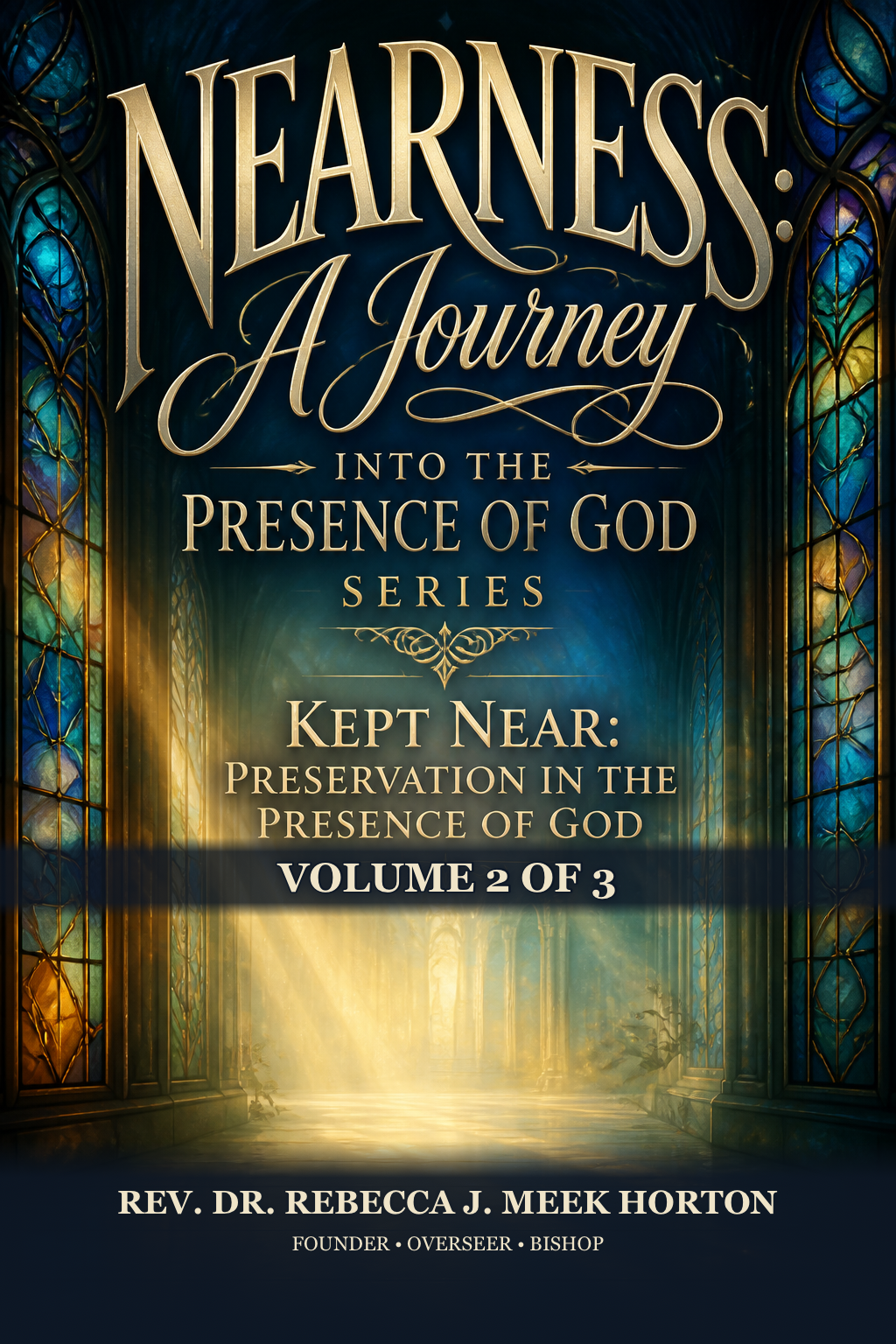
Nearness: A Journey into the Presence of GOD · Volume 2
Kept Near: Preservation in the Presence of GOD
Part 2 of 3 in the series "Nearness: A Journey into the Presence of GOD". Series theme: The peace, preservation, and power in the The Presence of GOD Series arc: This three-book series moves from receiving the peace of GOD’s presence, to living under His preserving care, to walking in the power that
Full publication
NBCNGMI MASTER KNOWLEDGE LIBRARY Featuring the works of The Sage, Apostle Prophet. Rev. Dr. Rebecca J. Meek Horton, Apostolic Prophetic Architect, NewBeing Creation Network Global Ministries, Inc. Integrated Framework Modalities™
Dedication
I dedicate this book to every soul being held steady in a season they did not choose. May you know that GOD’s presence does not always remove the pressure, but He is faithful to preserve you in it. Stay near, keep trusting, and let Him form endurance in you.
Purpose
I prepared this book for every soul learning that GOD’s preserving presence is not escape from hardship, but His faithful keeping in the midst of it.
My prayer is that these pages help you remain near Him through pressure, temptation, grief, weakness, fear, and uncertainty, with your trust strengthened by Psalm 91, Jude 1:24, and 2 Timothy 4:18.
May you learn to endure without striving, repent without shame, discern with wisdom, and keep the next faithful step under the care of the GOD who is able to keep you.
Preface
This book was born from the place where peace has to learn how to stand.
After the heart receives the quieting gift of GOD’s presence, life does not always become easier. Sometimes the pressure increases. Temptation speaks louder. Grief sits longer than expected. Fear tries to explain the future. Weakness reminds us that we are not able to keep ourselves.
That is where this book begins.
Kept Near is the second movement in the Nearness journey. The first book invited the heart to rest in the peace of GOD’s presence. This book speaks to the soul under pressure and says: GOD is not only near when the room is calm. He is near when the storm is real. His presence does not always remove the hard place, but He preserves His people in the middle of it.
Psalm 91:1-2 (KJV)
He that dwelleth in the secret place of the most High shall abide under the shadow of the Almighty. I will say of the LORD, He is my refuge and my fortress: my God; in him will I trust.
I have learned that preservation is not the same as avoidance. GOD may keep us by delivering us out, but He also keeps us by strengthening us through. He keeps our mind from being ruled by fear. He keeps our heart from hardening. He keeps our feet from turning aside. He keeps our witness from collapsing under pressure. He keeps calling us back when we drift.
Jude 1:24 (KJV)
Now unto him that is able to keep you from falling, and to present you faultless before the presence of his glory with exceeding joy,
These pages were written for everyone who needs to be reminded that being kept is not weakness. It is grace. It is mercy. It is the faithful care of GOD over a life that still needs Him every hour.
As you read, do not rush. Bring the real pressure with you. Bring the fear, the temptation, the grief, the uncertainty, and the place where endurance feels thin. Let the Word of GOD search you and steady you. Let the presence of GOD teach you how to repent quickly, discern wisely, endure honestly, and trust again.
Begin with one simple prayer: LORD, keep me near, and teach me how to remain with You where I am.
Introduction
There are seasons when peace has been received, but pressure still comes.
The heart has learned to quiet itself before GOD, yet the phone still rings with hard news. The body still grows tired. Temptation still looks for an opening. Grief still visits without asking permission. Fear still tries to explain the future. And somewhere in the middle of all of it, the soul asks a deeper question:
Will GOD keep me here?
This book begins with that question.
Kept Near is the second movement in the series Nearness: A Journey into the Presence of GOD. The first book turned the heart toward the peace of GOD’s presence. This book strengthens the soul to live under His preserving care. The third book will move toward the power that flows from abiding with Him. But here, in this middle place, we learn something necessary: preservation is not always escape from hardship. Often, preservation is GOD keeping His people faithful, guarded, corrected, comforted, and formed in the midst of hardship.
Psalm 91 does not invite us into denial. It invites us into dwelling.
Psalm 91:1-2 (KJV) He that dwelleth in the secret place of the most High shall abide under the shadow of the Almighty. I will say of the LORD, He is my refuge and my fortress: my God; in him will I trust.
The promise is not that nothing difficult will ever touch the life of the faithful. Scripture is too honest for that. Joseph was preserved through betrayal and prison. David was preserved while hunted. Elijah was preserved when he was afraid and exhausted. Paul was preserved through opposition, abandonment, and suffering. Jesus Himself was kept in perfect obedience through agony, rejection, and the cross.
So this book will not teach you to call pain easy. It will not ask you to pretend that grief is small, temptation is harmless, or uncertainty is simple. It will teach you to remain near GOD when life feels unstable, and to recognize His keeping hand even when the path is hard.
Jude gives us this strong and tender assurance:
Jude 1:24 (KJV) Now unto him that is able to keep you from falling, and to present you faultless before the presence of his glory with exceeding joy,
GOD is able to keep you.
That does not remove your responsibility. It restores it to the right place. You are not your own savior. You are not strong enough to preserve yourself by control, perfection, overthinking, avoidance, or fear. But you are invited to abide, repent, listen, discern, resist, endure, and take the next faithful step.
This is where our language must be healed.
Not, “I am alone in this.”
But, “GOD is keeping me as I remain near Him.”
Not, “Pressure means I have failed.”
But, “Pressure can reveal where GOD is forming endurance.”
Not, “I must control everything to be safe.”
But, “I must dwell near the One who preserves me.”
As you read, move slowly. Keep your Bible close. Do not rush past the Scriptures. Read them, interpret them faithfully, ponder them honestly, and steward what they reveal. Some chapters may comfort you. Some may correct you. Some may ask you to repent, set a boundary, confess fear, resist temptation, seek wise counsel, or stop letting instability govern your decisions.
That is part of being kept.
Preservation includes protection, but it also includes formation. GOD keeps us by sheltering us, yes. He also keeps us by correcting what would destroy us, strengthening what has grown weak, exposing what has been hidden, and teaching us to trust Him when we cannot see the whole road.
Paul’s words near the end of his life give this book its courage:
2 Timothy 4:18 (KJV) And the Lord shall deliver me from every evil work, and will preserve me unto his heavenly kingdom: to whom be glory for ever and ever. Amen.
That is not shallow confidence. That is mature trust. Paul had suffered. He had been opposed. He had been forsaken by some. Yet his testimony was clear: the Lord would preserve him.
This book is for every person who needs that kind of confidence.
Before you continue, pause for one quiet minute. Ask GOD to show you where fear, grief, temptation, or uncertainty has made you feel unkept. Write one honest sentence. Then pray simply:
Lord, teach me how to remain near You and trust Your keeping hand here.
Chapter 1 — When Nearness Feels Tested
The morning can begin with peace and still meet trouble before noon.
You may wake early, sit quietly, pray with a settled heart, and feel the mercy of GOD holding you. The room is still. The Word is open. Breath slows. For a few moments, you remember that you are not alone.
Then the phone rings.
A report changes. A bill arrives. A child says something that troubles you. A temptation returns. A grief you thought had softened rises again with strength. Someone’s tone cuts deeper than expected. The peace you received in the presence of GOD now feels surrounded by pressure.
And the question comes quietly.
Am I still being kept?
This is the first problem this book must name: after receiving the peace of GOD’s presence, pressure can make the soul wonder whether it is still under His preserving care. The single controlling idea of this chapter is simple: hardship does not mean GOD has withdrawn, and preservation begins by learning to stay near instead of running in fear.
Nearness will be tested.
Not because GOD is unstable.
Not because His presence is weak.
Not because your peace was false.
Nearness is tested because life in a broken world brings pressure, and pressure often tries to reinterpret what GOD has already spoken. The soul must learn a holy steadiness. When fear rises, stay near. When trouble comes, stay near. When you do not understand, stay near.
Preservation does not begin with pretending you are not shaken. It begins with bringing your shaken heart back into the presence of the One who keeps you.
Peace Can Be Tested Without Being Lost
Peace is not proven by the absence of disturbance.
A house can be built well and still feel the force of wind. A tree can be rooted deeply and still bend in a storm. A believer can be held by GOD and still tremble under pressure.
Many people mistake tested peace for lost peace. They think, “If I were really resting in GOD, this would not affect me so much.” But Scripture does not teach that the people of GOD never feel trouble. It teaches that GOD is present with them in trouble.
Psalm 46:1-3 (KJV)
God is our refuge and strength, a very present help in trouble. Therefore will not we fear, though the earth be removed, and though the mountains be carried into the midst of the sea; Though the waters thereof roar and be troubled, though the mountains shake with the swelling thereof. Selah.
The verse does not say there is no trouble. It says GOD is a very present help in trouble.
That matters.
If you expected the presence of GOD to remove every shaking, then every shaking will feel like abandonment. But if you understand that GOD is a refuge in the shaking, then pressure becomes a place to return, not a reason to run.
Think of a child learning to walk beside a parent through a crowded place. The noise may frighten the child. The movement of people may feel overwhelming. But the parent’s hand has not disappeared. The child may grip tighter because the place feels unsafe.
That is not failure.
That is trust under pressure.
There are seasons when your prayer life may look less like joyful confidence and more like holding on. There are days when worship comes with tears. There are nights when the only prayer you can form is, “Lord, keep me.”
That prayer is not small.
It is honest.
It is near.
The enemy of your soul would like you to believe that feeling shaken means you have been forsaken. But the Word of GOD gives better language.
Not, “I am shaken, so GOD must be gone.”
But, “I am shaken, so I will return to my refuge.”
That is RE-Language™ for the tested soul. It shifts the sentence from fear to faith, from accusation to return, from panic to stewardship.
Pressure Tries to Redefine Nearness
Pressure has a voice.
It does not only create difficulty. It tries to explain the difficulty.
It says, “If GOD were near, this would not be happening.”
It says, “If GOD were keeping you, you would not feel afraid.”
It says, “If you had more faith, you would not be struggling.”
It says, “You are on your own now.”
These statements may feel powerful, especially when the body is tired and the heart is already bruised. But a loud thought is not always a true thought.
This is where discernment begins, not as a complicated exercise, but as a faithful pause. The soul must learn to ask, “Who is interpreting this moment for me?”
Is fear interpreting it?
Is pain interpreting it?
Is accusation interpreting it?
Is Scripture interpreting it?
The first book in this journey helped quiet the heart in the peace of GOD’s presence. This second book begins where life often takes us next: into the pressure that tests whether peace will become trust.
The disciples knew something about this. They followed Jesus into a ship. They were not outside His will. They were not away from His presence. Yet a storm came.
Mark 4:37-40 (KJV)
And there arose a great storm of wind, and the waves beat into the ship, so that it was now full. And he was in the hinder part of the ship, asleep on a pillow: and they awake him, and say unto him, Master, carest thou not that we perish? And he arose, and rebuked the wind, and said unto the sea, Peace, be still. And the wind ceased, and there was a great calm. And he said unto them, Why are ye so fearful? how is it that ye have no faith?
Their question is painfully human: “Master, carest thou not that we perish?”
They were not asking if He had power. They had seen enough to know He had power. They were asking if His care was still toward them in the storm.
That is often the question under our fear too.
Not always, “Can GOD?”
Sometimes, “Does GOD care here?”
Jesus did not abandon them for asking. He met them, corrected them, and revealed His authority over what frightened them.
But we should notice this: the storm did not mean Jesus was absent. He was in the ship.
The presence of trouble did not cancel the presence of Christ.
There are times when you will need to say that slowly to your own soul: trouble is present, but Christ is present too.
This is not denial. Denial says, “There is no storm.” Faith says, “There is a storm, and Jesus is Lord here.”
Preservation Begins With Staying Near
When fear rises, the instinct may be to run.
Some run into control. They try to manage every detail, every person, every possible outcome.
Some run into distraction. They fill the silence so they do not have to feel the ache.
Some run into isolation. They pull away from prayer, worship, counsel, and community because they feel too exposed.
Some run into old patterns. A familiar compromise can feel like relief when pressure becomes heavy.
But preservation begins when we refuse to let fear drive us away from GOD.
Psalm 73 gives us the honesty of a man whose soul was troubled by what he saw. He looked at the prosperity of the wicked and felt the strain of it. His thoughts became heavy. His footing nearly slipped. But the turning point came when he entered the sanctuary of GOD.
Psalm 73:16-17 (KJV)
When I thought to know this, it was too painful for me; Until I went into the sanctuary of God; then understood I their end.
He did not receive understanding by running farther into his own distress. He received understanding by returning to the presence of GOD.
That is not just a location. It is a posture.
It is the decision to bring the troubled thought into GOD’s presence before allowing it to become your conclusion.
A woman may sit in her car before going into the house and whisper, “Lord, I am afraid of what I may face inside. Keep my mouth. Keep my heart. Help me walk in truth.”
A man may pause before responding to a message and pray, “Lord, do not let pain answer through me. Give me wisdom.”
A caregiver may stand at the sink, exhausted, and say, “GOD, I need grace for the next hour.”
A grieving person may place a hand over the heart and say, “I do not understand this sorrow. But I am here with You.”
These are not dramatic moments to others. But heaven sees them. These are acts of staying near.
Psalm 16:8 (KJV)
I have set the Lord always before me: because he is at my right hand, I shall not be moved.
“I have set the Lord always before me” is not passive. It is intentional. It is practiced attention. It is choosing what will stand in front of the soul when pressure tries to take over the whole room.
This is where daily nearness becomes preserving strength.
Not because your practice earns GOD’s care.
Not because you are keeping yourself by perfect discipline.
But because you are learning to remain where grace can meet you, correct you, comfort you, and steady you.
The First Step Is Not Flight, But Return
There is a moment between pressure and reaction.
It may be brief, but it is holy ground.
In that moment, the soul can either be driven by fear or turned again toward GOD. This does not mean every emotion becomes calm immediately. It means fear does not get to lead without being questioned.
A simple rhythm can help: Wait, Ask, Listen, Keep.
Wait in stillness, even if only for one minute.
Ask honestly, “Lord, what is true here?”
Listen carefully to Scripture, conviction, wisdom, and the witness of peace.
Keep the next faithful step.
This is not a formula to control outcomes. It is a way to remain near when pressure wants to scatter you.
Isaiah 26:3-4 (KJV)
Thou wilt keep him in perfect peace, whose mind is stayed on thee: because he trusteth in thee. Trust ye in the Lord for ever: for in the Lord JEHOVAH is everlasting strength:
The kept mind is a stayed mind.
That does not mean the mind never feels concern. It means the mind is brought back, again and again, to the Lord. Stayed does not always mean effortless. Sometimes stayed means returned.
Returned after panic.
Returned after tears.
Returned after a hard conversation.
Returned after bad news.
Returned after realizing your thoughts have been running ahead of grace.
This is part of spiritual maturity. You learn to notice when your inner life has drifted from nearness into fear. Then you come back without shame.
Not, “I failed because I felt afraid.”
But, “Fear is present, and I am returning to GOD.”
The soul that learns to return quickly is being trained in preservation.
You may not be able to stop every storm. You may not be able to remove every uncertainty. You may not be able to make people choose rightly. You may not be able to answer every question tonight.
But you can return.
You can open your Bible.
You can pray the truth.
You can ask for counsel.
You can refuse the lie.
You can take the next faithful step.
This is how nearness becomes strength under pressure.
The Cost of Staying Near
Staying near sounds gentle, and it is. But it is not always easy.
It will cost you the right to let fear explain everything.
It will cost you the comfort of rehearsing worst-case stories as if they are prophecy.
It will cost you the false safety of control.
It will cost you the habit of running to old refuges that cannot keep you.
It may require you to sit quietly when you would rather react. It may require you to pray before answering. It may require you to admit, “I am afraid,” without letting fear become lord. It may require you to stop calling distance “self-protection” when GOD is inviting you back into trust.
There is also the cost of honesty.
Staying near does not mean speaking religious words while hiding what is really happening inside. GOD does not preserve a pretend version of you. He calls the real you near.
Psalm 139:23-24 (KJV)
Search me, O God, and know my heart: try me, and know my thoughts: And see if there be any wicked way in me, and lead me in the way everlasting.
That prayer takes courage.
It invites GOD into the places where fear, resentment, unbelief, pride, grief, and exhaustion may be tangled together. It asks Him not only to comfort, but to search. Not only to soothe, but to lead.
This is where preservation begins to form maturity. GOD’s keeping care does not only protect you from outside pressure. It also addresses what pressure reveals inside you.
That is mercy.
Pressure may reveal that your peace was tied to circumstances more than you knew. It may reveal that your trust weakens when you cannot see the next step. It may reveal that you have been calling control wisdom. It may reveal that you have been carrying burdens GOD never asked you to carry alone.
Do not despise what is revealed.
Bring it near.
The presence of GOD is not only a place of comfort. It is a place of truth. And truth, when received with humility, becomes part of how GOD preserves us.
A Clear Beginning
This chapter is not asking you to understand every hardship.
It is not asking you to call pain good.
It is not asking you to deny fear, grief, temptation, weakness, or uncertainty.
It is asking you to begin here: when nearness feels tested, do not assume GOD has left. Do not let pressure become your interpreter. Do not run from the One who keeps you.
Stay near.
If you can only stay near with a whisper, whisper.
If you can only stay near with tears, weep before Him.
If you can only stay near by opening the Word and sitting quietly, sit.
If you need help from a pastor, counselor, doctor, mature believer, or trusted friend, receive wise care as stewardship, not shame.
Being kept does not mean you never need support. It means you belong to GOD in the very place where support is needed.
The journey of this book will move through pressure, temptation, repentance, weakness, grief, endurance, and final hope. But the first step is this: when the soul feels tested, return to the presence of GOD.
He is not frightened by your storm.
He is not surprised by your tears.
He is not confused by your questions.
He is able to keep you as you learn to stay near.
Key Takeaways
• Pressure can test felt nearness without proving GOD has withdrawn.
• Hardship is not the same as absence; GOD is present help in trouble.
• Preservation begins when you return to GOD instead of running in fear.
Practice
Set aside ten quiet minutes today.
Bring one current pressure before GOD. Do not explain it away. Do not exaggerate it. Name it simply.
Then write three short sentences:
• The pressure I am facing is __________.
• The fear trying to interpret it is __________.
• The truth I will return to is __________.
After you write, pray this slowly:
Lord, I feel the pressure, but I will not let fear tell me You are absent. Keep me near. Teach me to return before I react. Help me take the next faithful step with You. Amen.
Chapter 2 — Kept Is Not the Same as Untouched
There is a kind of prayer that comes from the floor.
Not polished. Not planned. Not spoken with a strong voice.
Just a person sitting beside a bed, or leaning over a kitchen sink, or parked in a car after a hard conversation, whispering, “Lord, I thought You were keeping me. Why does this still hurt?”
That question is not strange.
It rises when trouble stays longer than expected. It rises when obedience does not prevent pressure. It rises when faithfulness is followed by warfare, sickness, grief, betrayal, delay, or loss.
Many people quietly believe that if GOD is keeping them, they should not be touched by trouble. So when trouble comes, they wonder if they have stepped outside His care.
But Scripture gives us a deeper promise.
GOD’s preservation does not mean His people are never touched by hardship. It means they are not abandoned to hardship. He shelters, sustains, corrects, strengthens, and finally delivers His people in His faithful hands.
That is the promise we must learn to receive.
Kept does not mean untouched.
Kept means held.
The Promise We Often Misread
A mother sits in a waiting room while her child is in surgery. She has prayed. Her church has prayed. She believes GOD is able to heal. Still, the clock moves slowly, and fear tries to speak.
A man loses work after years of showing up faithfully. He wonders why GOD did not prevent the loss.
A widow returns to an empty house after the funeral and feels the ache in every room.
A young believer resists one temptation only to be pressed by another.
In those moments, the soul may reach for a simple explanation. If GOD is with me, this should not be happening. If He is keeping me, I should feel stronger. If I am under His care, the trouble should have passed by now.
But Scripture does not teach that the presence of GOD removes every wound from the life of His people.
Joseph was kept, but he was sold by his brothers. He was kept, but he was falsely accused. He was kept, but he spent years in prison before the purpose was visible.
Daniel was kept, but he still entered the lions’ den.
The three Hebrew men were kept, but they still entered the furnace.
Paul was kept, but he endured shipwreck, imprisonment, opposition, and weakness.
Even our Lord Jesus, beloved of the Father, was led through suffering, rejection, and the cross.
So we must be careful not to build a promise GOD did not make, then lose heart when life refuses to honor it.
GOD does preserve His people.
But preservation is not the same as insulation.
Insulation says, “Nothing painful will reach me.”
Preservation says, “Nothing can separate me from the faithful keeping of GOD.”
This matters because a wrong expectation can become a doorway for accusation. If we think nearness means no trouble, then trouble will feel like proof of distance. But if we understand that GOD keeps His people in the midst of trouble, then trouble does not get the final word over our interpretation.
Psalm 91 speaks with strong language about shelter and deliverance. It is a beloved passage, and rightly so. But it must be read with reverence, not used as a formula to control outcomes. It teaches us to dwell, trust, and rest under GOD’s care. It does not give us permission to test GOD or pretend life has no danger.
Psalm 91:1-4 (KJV)
He that dwelleth in the secret place of the most High shall abide under the shadow of the Almighty. I will say of the LORD, He is my refuge and my fortress: my God; in him will I trust. Surely he shall deliver thee from the snare of the fowler, and from the noisome pestilence. He shall cover thee with his feathers, and under his wings shalt thou trust: his truth shall be thy shield and buckler.
The first word that carries weight here is dwell.
Not visit.
Not run in only when afraid.
Not use the secret place as a spiritual emergency room and then return to self-reliance.
Dwell.
The promise is relational before it is circumstantial. The soul that dwells learns to say, “He is my refuge and my fortress.” That confession does not deny the snare. It does not deny the pestilence. It does not deny the need for a shield.
It names GOD as refuge while danger is still real.
This is where we must RE-Language™ the way we speak about being kept.
Not, “If GOD were keeping me, I would not be facing this.”
But, “GOD is keeping me in this, and I will not let trouble define His presence.”
That one shift may not remove the pain, but it can steady the soul.
Shelter Does Not Mean No Storm
A shelter matters because weather exists.
No one builds a refuge in a world where nothing threatens. No one needs a fortress where there is no enemy. No one speaks of wings covering the vulnerable unless there is something from which they need covering.
Psalm 91 does not describe a harmless world. It describes a faithful GOD.
That is an important difference.
Many believers read the promises of shelter and quietly expect a life without impact. But the language of shelter assumes pressure. The presence of a refuge does not prove there will be no storm. It proves there is a place to run when the storm rises.
Think of a child standing under a large umbrella with a parent. The rain may still fall. The wind may still blow. The child may still hear thunder and feel the cold air. But the child is not standing alone in the open. The covering does not erase the weather. It changes the child’s position in it.
So it is with GOD’s preserving presence.
He may keep you by closing a door before you walk through it.
He may keep you by strengthening you while you walk a hard road.
He may keep you by exposing what is false before it destroys you.
He may keep you by giving wisdom through counsel.
He may keep you by allowing discomfort to turn you from danger.
He may keep you by giving peace that does not match the circumstance.
He may keep you by bringing you through loss with a heart still able to trust Him.
Preservation has many forms.
Sometimes it looks like prevention. Sometimes it looks like endurance. Sometimes it looks like correction. Sometimes it looks like recovery. Sometimes it looks like the quiet miracle that you are still praying, still breathing, still turning toward GOD after everything you have endured.
We often want preservation to mean, “Do not let anything happen to me.”
But GOD’s keeping often means, “I will be with you, and I will not let what happens have ultimate authority over you.”
This does not make hardship small.
There are losses that change the shape of a person’s life. There are betrayals that require long healing. There are seasons of uncertainty that stretch the nervous system, the emotions, and the faith. There are prayers that do not resolve quickly.
Christian maturity does not require us to pretend these things are easy.
Truthfulness is part of faithfulness.
The Word of GOD does not ask us to call pain pleasant. It asks us to bring pain under the care and authority of GOD.
Psalm 91 later gives language for this holy nearness.
Psalm 91:14-16 (KJV)
Because he hath set his love upon me, therefore will I deliver him: I will set him on high, because he hath known my name. He shall call upon me, and I will answer him: I will be with him in trouble; I will deliver him, and honour him. With long life will I satisfy him, and shew him my salvation.
Notice the phrase: “I will be with him in trouble.”
Not only before trouble.
Not only after trouble.
In trouble.
That is preserving presence.
The trouble may be real, but it is not empty of GOD. The pressure may be intense, but it is not proof that you are uncovered. The pain may be honest, but it is not authorized to preach that GOD has left you.
Shelter does not mean no storm.
Shelter means GOD is your refuge while the storm is speaking.
Grace That Keeps You Standing
Some seasons do not feel dramatic from the outside.
There is no visible crisis. No one knows you are fighting discouragement in the morning or fear at night. No one sees how much effort it takes to stay gentle, stay sober, stay prayerful, stay honest, stay obedient.
But GOD knows.
Preservation is not only about being protected from external danger. It is also about being kept from falling away inwardly.
This is where Jude speaks to the soul with great hope.
Jude 1:24-25 (KJV)
Now unto him that is able to keep you from falling, and to present you faultless before the presence of his glory with exceeding joy, To the only wise God our Saviour, be glory and majesty, dominion and power, both now and ever. Amen.
“Now unto him that is able.”
That phrase lifts the burden from self-sufficiency.
You are not the keeper of your own soul in the ultimate sense. You are responsible to respond, obey, repent, watch, pray, and walk wisely. But your confidence is not in the strength of your grip on GOD. Your confidence is in His power to keep you.
This does not create laziness. It creates humility.
A person who knows they are being kept does not say, “I can do whatever I want.” That is presumption. A person who knows they are being kept says, “I need GOD for every step, and I will not boast in my own strength.”
Grace keeps us from falling, not so we can be careless, but so we can be faithful.
Imagine a person learning to walk again after an injury. The therapist may stand close, steadying them as they take slow steps. The presence of support does not mean the person has no responsibility. They must still engage. They must still move. They must still follow instruction. But they are not left alone to collapse.
GOD’s sustaining grace is stronger than that picture, but it helps us understand the posture.
We participate, but we do not preserve ourselves.
We obey, but we do not boast.
We resist sin, but we do not pretend we are beyond temptation.
We endure, but we do not call endurance our own invention.
We are kept by the power and mercy of GOD.
This is especially important for the believer who feels weak. When your emotions are tired, when your body is limited, when grief has made concentration difficult, when the old temptation feels near, the enemy may accuse you: “You are not strong enough to make it.”
The accusation may be partly true and still deeply deceptive.
No, you are not strong enough in yourself.
But you are not kept by yourself.
That is the difference.
Preservation does not flatter human pride. It teaches dependence.
The steady believer is not the one who never feels pressure. The steady believer is the one who learns where to lean under pressure.
Paul’s words near the end of his life give this truth a final and eternal weight.
2 Timothy 4:18 (KJV)
And the Lord shall deliver me from every evil work, and will preserve me unto his heavenly kingdom: to whom be glory for ever and ever. Amen.
Paul wrote as a man who knew suffering. He was not speaking from a life untouched by trouble. He was speaking as one who had been opposed, imprisoned, deserted, and poured out.
Still, he could say, “the Lord shall deliver me” and “will preserve me unto his heavenly kingdom.”
That does not mean Paul expected every painful earthly outcome to be removed. It means he trusted the Lord’s final faithfulness. Evil would not own him. Death would not defeat GOD’s purpose. The kingdom was sure.
This is not shallow comfort. This is deep anchoring.
The Lord who keeps you today is also preserving you unto His heavenly kingdom. His care is present and eternal. He is not only managing the moment. He is keeping you for the fullness of salvation.
So when life feels unstable, do not measure GOD’s keeping only by what changed today.
Measure it also by what cannot be taken.
Christ is still Lord.
Grace is still grace.
The Spirit is still present.
The Word is still true.
Your future in Him is still held.
The heavenly kingdom is still sure.
That is not denial. That is durable hope.
Final Faithfulness Changes Present Fear
Fear narrows vision.
It makes today feel like forever. It makes this diagnosis, this bill, this conflict, this grief, this weakness, this uncertainty feel like the whole story.
But GOD’s preserving care stretches our vision beyond the immediate.
This does not mean we ignore today’s responsibilities. It means we do not let today’s trouble pretend to be eternal.
When Paul says the Lord will preserve him unto His heavenly kingdom, he is not escaping reality. He is seeing reality more fully. He sees the prison, the opposition, the danger, and the nearness of death. But he also sees the kingdom.
The kingdom changes how trouble is interpreted.
If this life is all there is, then every loss becomes ultimate. Every threat becomes final. Every delay becomes unbearable. Every weakness becomes a verdict.
But if GOD is preserving His people unto His heavenly kingdom, then trouble is real but not final.
This is where peace and preservation meet.
The first book in this journey taught the heart to quiet itself in the presence of GOD. But now, under pressure, that quiet must become endurance. Peace is not only for still rooms and calm mornings. Peace must learn to breathe in the hallway of the hospital, at the graveside, in the courtroom, in the unemployment line, in the family conflict, and in the private battle no one else sees.
Preservation carries peace into pressure.
It says, “I am still under GOD’s care.”
It says, “This trouble is not stronger than His keeping.”
It says, “I may not understand the timing, but I will not surrender my trust.”
It says, “I can take the next faithful step because I am not walking alone.”
This does not come automatically. It must be practiced.
When fear rises, you may need to pause before you speak. You may need to refuse the first interpretation that panic offers. You may need to open Scripture before opening another stream of opinions. You may need to ask a trusted believer to pray with you. You may need to rest your body, eat a real meal, take prescribed medicine, call a counselor, or step away from noise.
These are not signs that faith is absent.
They can be acts of stewardship under GOD’s care.
Being kept does not mean you stop participating in wisdom. It means you participate without believing everything depends on you.
There is a quiet freedom in that.
You can do the next right thing without carrying the full weight of the outcome.
You can repent without drowning in shame.
You can grieve without concluding GOD has failed you.
You can resist temptation without pretending you are above it.
You can ask for help without calling yourself weak in the wrong way.
You can wait without letting fear explain everything.
Final faithfulness gives courage for present obedience.
The Cost of Receiving This Promise
There is a cost to believing that kept is not the same as untouched.
The cost is that we must release the demand to understand every part of GOD’s preserving work while we are still in the middle of it.
That is hard.
We want the map. We want the reason. We want the timeline. We want proof that the pain will not last long and that every outcome will look like what we prayed for.
Sometimes GOD gives clear direction. Sometimes He gives relief quickly. Sometimes He opens the door, heals the body, restores the relationship, provides the resource, or removes the danger.
And sometimes He keeps us while the trouble continues.
That kind of keeping requires trust.
It asks us to stop using comfort as the only evidence of GOD’s nearness. It asks us to stop measuring His faithfulness by how quickly pressure lifts. It asks us to stay near when fear tells us to run, accuse, numb, control, or compromise.
This is not passive.
Staying near may be the bravest thing you do.
It may look like praying again after disappointment.
It may look like reading Psalm 91 slowly instead of spiraling through fear.
It may look like saying, “Lord, I do not understand, but I will not call You absent.”
It may look like receiving correction.
It may look like letting someone help you.
It may look like choosing obedience when bitterness would feel easier.
Preservation does not remove all cost from the life of faith.
It gives us GOD Himself in the cost.
And He is faithful.
Key Takeaways
• GOD’s preservation means held, not untouched.
• Trouble is real, but it is not proof of GOD’s absence.
• The Lord keeps His people now and unto His heavenly kingdom.
Practice
Choose one current pressure you are facing. Write it in one clear sentence.
Then write this sentence beneath it:
GOD’s keeping is not canceled by this trouble.
Read Psalm 91:1-4, Jude 1:24-25, and 2 Timothy 4:18 slowly. Do not rush. After each passage, ask:
Lord, how are You calling me to trust Your keeping here?
Then take one faithful step today. Not ten. One.
Make the phone call. Pray honestly. Rest your body. Ask for counsel. Repent where needed. Open your Bible before fear takes the lead.
Stay near.
You are not untouched.
You are being kept.
Chapter 3 — The Secret Place Under Pressure
The siren sounded before the rain came.
A family moved quickly through the house, gathering children, shoes, flashlights, and a small bag of medicine. The youngest child stood in the hallway with wide eyes, listening to the wind press against the windows. He did not understand weather patterns. He did not know how to read radar. He only knew that the adults were saying, “Come close. Stay here. Do not run around the house.”
The safe place did not stop the storm from existing.
It gave the family a place to remain while the storm passed over.
Many of us want the presence of GOD to mean the storm never reaches the sky above us. Psalm 91 teaches something deeper. It teaches us to dwell, abide, and trust when life feels unsafe. The secret place is not a hiding place from responsibility. It is a place of renewed dependence under GOD’s care.
That is the controlling idea of this chapter: GOD preserves the soul under pressure by teaching us to stay near, not by teaching us to escape every hard place.
Psalm 91 does not invite us into denial. It does not say there is no terror, no arrow, no pestilence, no destruction, no trouble. It names danger plainly. But it also names the keeping presence of GOD more plainly.
The call is not, “Pretend nothing can hurt.”
The call is, “Dwell.”
Dwelling Is More Than Visiting
Psalm 91 begins with a posture before it gives a promise.
Psalm 91:1-2 (KJV)
He that dwelleth in the secret place of the most High shall abide under the shadow of the Almighty. I will say of the LORD, He is my refuge and my fortress: my God; in him will I trust.
The first word that matters here is dwelleth.
Not visits.
Not passes through.
Not remembers occasionally.
Dwelleth.
To dwell is to remain. It is to make a home. It is to return so often that nearness becomes the normal place of the soul. The person in Psalm 91 is not using GOD as a spiritual emergency room only when life becomes unbearable. This person is learning to live under GOD’s covering presence.
That matters because pressure reveals where we have been dwelling.
Some people dwell in the news.
Some dwell in fear.
Some dwell in old wounds.
Some dwell in control.
Some dwell in the opinions of people.
Some dwell in worst-case thinking.
Then trouble comes, and the soul reaches for the place it has practiced living.
This is not written to shame us. It is written to call us back.
If fear has become your familiar place, you can return to the secret place. If anxiety has become the room where your mind spends the night, you can return to the Most High. If pressure has trained you to run, numb, accuse, or withdraw, GOD can teach you to dwell again.
A person may sit in a church service and still dwell in fear. A person may carry a Bible and still dwell in resentment. A person may know correct doctrine and still dwell in the need to control every outcome.
Dwelling is not only about where your body is.
It is about where your trust rests.
Psalm 91 gives us words for a soul that has chosen its refuge: “He is my refuge and my fortress: my God; in him will I trust.”
Notice the personal language.
My refuge.
My fortress.
My God.
In him will I trust.
There are seasons when you must say this out loud before your emotions agree. Not as empty repetition. Not as religious noise. As faithful re-language for a pressured soul.
Not, “I am unsafe because life feels unstable.”
But, “GOD is my refuge while life feels unstable.”
Not, “I have to carry this alone.”
But, “I will return to the secret place and receive the grace to carry my part.”
Not, “Pressure means GOD has left me.”
But, “Pressure is calling me to abide under His shadow.”
A shadow means nearness. You cannot stand under someone’s shadow from far away. Psalm 91 is not first about mastering danger. It is about remaining near the Almighty.
Think of a child walking beside a parent on a crowded street. The parent may not remove the crowd. The parent may not silence every sound. But the child is kept by staying close, holding the hand, listening for direction, and not wandering into traffic.
The secret place is like that.
It is not a refusal to walk.
It is learning where to walk from.
The Secret Place Names Danger Honestly
Psalm 91 is full of strong promises, but it does not flatter us with a soft world.
Psalm 91:3-6 (KJV)
Surely he shall deliver thee from the snare of the fowler, and from the noisome pestilence. He shall cover thee with his feathers, and under his wings shalt thou trust: his truth shall be thy shield and buckler. Thou shalt not be afraid for the terror by night; nor for the arrow that flieth by day; Nor for the pestilence that walketh in darkness; nor for the destruction that wasteth at noonday.
There is a snare.
There is pestilence.
There is terror by night.
There is an arrow by day.
There is destruction at noonday.
This is not fragile faith. This is faith with open eyes.
The secret place does not require you to deny that life can be painful, uncertain, or dangerous. It teaches you not to let danger become your god.
Fear wants to become the interpreter of everything.
Fear says, “Because there is danger, you are not kept.”
Psalm 91 says, “Because GOD is your refuge, danger does not have the final word.”
This distinction matters. If we read Psalm 91 as a promise that nothing difficult will ever touch faithful people, we will become confused when hardship comes. We may begin to accuse ourselves, accuse others, or accuse GOD. But Scripture is honest. GOD’s people have endured famine, prisons, grief, persecution, sickness, betrayal, exile, and death. Preservation is not always exemption from contact with pain. It is GOD’s faithful keeping in the middle of what would otherwise destroy the soul.
The image of feathers and wings is tender.
“He shall cover thee with his feathers, and under his wings shalt thou trust.”
A bird covers her young not because there is no threat, but because there is one. The covering does not mean the young are strong enough in themselves. It means they are sheltered by another.
This is hard for proud hearts.
We often want GOD to preserve us in a way that still lets us feel self-sufficient. We want help without dependence. We want covering without closeness. We want protection without surrender.
But the secret place humbles us.
It teaches us to be kept.
That may sound simple, but it is not always easy. To be kept means I am not the keeper of everything. I am not sovereign. I am not all-seeing. I am not able to secure every future outcome. I have responsibility, but I do not have ultimate control.
There is relief in that.
There is also a cost.
The cost is releasing the illusion that worry is protection.
Many people think worry is a form of love. They think if they stop worrying, they are being careless. But worry does not shelter the people we love. Worry does not heal the body. Worry does not govern tomorrow. Worry does not make us wise.
Trust does not mean we stop caring.
Trust means we bring our care under GOD.
A mother praying for a child is not doing nothing. A man seeking counsel before a hard decision is not doing nothing. A widow bringing grief before GOD day after day is not doing nothing. A believer choosing obedience when afraid is not doing nothing.
They are dwelling.
They are returning.
They are allowing truth to become shield and buckler.
Psalm 91 says, “his truth shall be thy shield and buckler.” GOD’s truth is not decorative. It is protective. It guards the mind when fear invents stories. It guards the heart when circumstances feel louder than Scripture. It guards the will when pressure offers shortcuts.
A shield is not useful if it is left on the wall.
Truth must be taken up, spoken, believed, practiced, and returned to.
When life feels unsafe, ask a simple question: What truth has GOD already given me for this pressure?
Not every question will be answered immediately. Not every outcome will be explained. But GOD’s truth gives enough light to remain near.
Refuge Is Not Refusal of Responsibility
Some people misunderstand the secret place as if it were an excuse to avoid life.
They think dwelling in GOD means they do not have to make the phone call, keep the appointment, apologize, set the boundary, seek counsel, go to work, take medicine, grieve honestly, or obey what they already know.
But Psalm 91 does not teach passivity. It teaches dependence.
There is a difference.
Passivity says, “I will do nothing and call it trust.”
Dependence says, “I will obey from a place of nearness, not panic.”
The secret place is not a cave for avoidance. It is a place where the soul is steadied so it can walk faithfully.
Psalm 91:9-11 (KJV)
Because thou hast made the LORD, which is my refuge, even the most High, thy habitation; There shall no evil befall thee, neither shall any plague come nigh thy dwelling. For he shall give his angels charge over thee, to keep thee in all thy ways.
The phrase “thy habitation” returns us to dwelling. The LORD is not being treated as a temporary shelter only until we find something else. He is the habitation. He is the place the soul lives.
Then the psalm says, “to keep thee in all thy ways.”
Ways involve movement.
The keeping of GOD goes with His people as they walk in His will. It does not bless recklessness. It does not sanctify presumption. It does not mean we create danger to prove GOD can rescue us. It means that as we walk in faithful obedience, GOD is able to keep us.
There is a holy balance here.
We do not preserve ourselves by fear.
We do not endanger ourselves by foolishness.
We walk with GOD.
A person who trusts GOD with health still practices stewardship. A person who trusts GOD with provision still works honestly. A person who trusts GOD with family still speaks truth in love. A person who trusts GOD with grief still allows tears. A person who trusts GOD with calling still prepares, learns, and obeys.
The secret place sends us back into responsibility with a quieter heart.
Consider someone facing a difficult medical report. Avoidance may say, “I will not open the envelope. I will not make the appointment. I will not tell anyone. I will just say I trust GOD.”
But dependence says, “GOD is my refuge. I will pray. I will ask for wisdom. I will go to the appointment. I will seek wise counsel. I will not let fear make me hide from what needs attention.”
That is not unbelief.
That is stewardship.
Or consider someone in a strained relationship. Avoidance says, “I am staying in prayer,” while using prayer as a way to delay the honest conversation. Dependence says, “I will meet GOD in the secret place first, so I do not speak from panic, revenge, or accusation. Then I will take the next faithful step.”
The secret place is where motives are softened, fear is quieted, and obedience is clarified.
It is where we stop asking only, “How do I get out of this?”
And begin asking, “How do I remain faithful with GOD in this?”
This is where WALK becomes practical.
Wait in stillness.
Ask honestly.
Listen carefully.
Keep the next faithful step.
Under pressure, we often want ten steps, a guarantee, and a full explanation. GOD often gives enough grace for the next act of obedience.
The secret place trains us to receive that grace.
Love Holds Fast Under Pressure
Near the end of Psalm 91, the voice shifts. GOD speaks.
Psalm 91:14-16 (KJV)
Because he hath set his love upon me, therefore will I deliver him: I will set him on high, because he hath known my name. He shall call upon me, and I will answer him: I will be with him in trouble; I will deliver him, and honour him. With long life will I satisfy him, and shew him my salvation.
These verses are deeply comforting, but we must read them carefully.
GOD does not say, “He will never see trouble.”
He says, “I will be with him in trouble.”
That one sentence can hold a weary soul.
“I will be with him in trouble.”
Not only after trouble.
Not only when trouble is explained.
Not only when trouble is removed.
With him in trouble.
This is the heart of preservation in the presence of GOD. The presence of trouble does not cancel the presence of GOD.
There are times when deliverance means the door opens quickly. There are times when deliverance means strength to endure another day. There are times when deliverance means the soul is guarded from bitterness, despair, compromise, or collapse. There are times when deliverance is final and eternal, when GOD brings His people safely into His heavenly kingdom.
But in every faithful form of deliverance, GOD remains true.
Psalm 91 says, “Because he hath set his love upon me.”
This is covenant language. It speaks of attachment, devotion, and clinging trust. Under pressure, love is tested. Not because GOD is cruel, but because pressure reveals what has our deepest loyalty.
Will I still call upon Him when I do not understand?
Will I still trust His name when I cannot trace His hand?
Will I still return to the secret place when another refuge looks faster?
Will I still obey when fear offers an easier explanation?
This is not about earning GOD’s care. We do not manipulate GOD into faithfulness by loving Him well enough. GOD is faithful because He is GOD. But love keeps us turned toward Him. Love keeps us near enough to receive what fear would make us abandon.
A person can be in the house and still refuse comfort. A person can be offered help and still turn away. A person can be near the table and still not eat.
Setting our love upon GOD is the soul saying, “I will not make another refuge my home.”
This becomes especially important when life feels unsafe.
Unsafe seasons often tempt us to attach ourselves to lesser shelters. We may run to control, anger, distraction, spending, food, isolation, constant talking, constant scrolling, or the need for someone else to tell us we will be okay every hour.
Some of those things may look harmless at first. But if they become our refuge, they begin to govern us.
The secret place calls us back to GOD as our first shelter.
Not our last resort.
Our first shelter.
This does not mean we reject people. GOD often preserves us through community, wise counsel, pastoral care, practical help, and loving presence. But people are not meant to become replacements for GOD. They can walk with us. They cannot be the Most High.
When you are under pressure, it is wise to ask: Where am I running first?
If the first place is fear, return.
If the first place is control, return.
If the first place is accusation, return.
If the first place is numbness, return.
The secret place is still open.
The Cost of Staying Near
Staying near sounds comforting until pressure makes running easier.
There is a cost to dwelling in the secret place.
The cost is stillness when panic wants motion.
The cost is honesty when denial feels safer.
The cost is obedience when avoidance feels easier.
The cost is trust when control feels more powerful.
The cost is returning daily, not only when the feeling is strong.
Psalm 91 is not a charm to recite while living far from GOD. It is not a spiritual slogan to place over an unchanged life. It is an invitation into abiding dependence.
That means we must let GOD examine the places where we have treated Him as shelter but not Lord.
We may want His protection while resisting His correction.
We may want His comfort while ignoring His instruction.
We may want His promises while refusing His presence.
But the secret place is relational. It is not mechanical. GOD is not a system to operate. He is the Most High, the Almighty, the LORD, the refuge, the fortress, the One who answers, the One who is with us in trouble.
Staying near also asks us to live with mystery.
Psalm 91 is true. GOD is faithful. And still, faithful people may suffer. Faithful people may grieve. Faithful people may walk through danger. Faithful people may not receive the outcome they prayed for in the way they hoped.
We must not use this psalm to accuse the wounded.
We must not say, “If you had trusted more, nothing hard would have happened.”
That is not pastoral. That is not faithful.
Instead, we say, “GOD is able to keep you even here. Let us return to Him together.”
The secret place is not a weapon to use against sufferers.
It is shelter for sufferers.
It is where the frightened are steadied.
It is where the grieving are held.
It is where the tempted are warned.
It is where the weary are renewed.
It is where the obedient are strengthened.
It is where the soul learns to say again, “My God; in him will I trust.”
You may not be able to change the whole situation today.
You can return to the secret place today.
You can pause before reacting.
You can speak Psalm 91:1-2 slowly.
You can name GOD as your refuge before you name the pressure as final.
You can ask, “Lord, what is my next faithful step from a place of nearness?”
That is not small.
That is how endurance begins to take root.
Key Takeaways
• The secret place is a life of dwelling near GOD, not a quick visit in crisis.
• Psalm 91 names real danger, but teaches that danger does not have the final word.
• GOD’s refuge strengthens responsibility; it does not excuse avoidance.
Practice
Set aside ten quiet minutes today.
Read Psalm 91:1-2 slowly, out loud if possible.
Psalm 91:1-2 (KJV)
He that dwelleth in the secret place of the most High shall abide under the shadow of the Almighty. I will say of the LORD, He is my refuge and my fortress: my God; in him will I trust.
Then write three short lines:
GOD, the pressure I am facing is:
GOD, the false refuge I am tempted to run to is:
GOD, my next faithful step from the secret place is:
Do not try to solve your whole life in one sitting.
Return.
Dwell.
Trust.
Then take the next faithful step.
Chapter 4 — Discern the Voice That Drives You
The text message was already typed.
Only one sentence.
I cannot do this anymore.
Her thumb hovered over send. Her chest was tight. Her thoughts were moving faster than wisdom could catch them. Part of her wanted relief. Part of her wanted escape. Part of her wanted someone else to feel the weight she had been carrying in silence.
But another part of her knew this was not the moment to decide.
So she put the phone face down, sat on the edge of the bed, and whispered, “Lord, what is driving me right now?”
That question can save a soul from many unnecessary wounds.
The controlling idea of this chapter is simple: not every voice inside you is worthy of your obedience. Fear, impulse, accusation, and GOD’s truth can all feel strong in a pressured moment, but they do not lead to the same place. If you are going to remain near under pressure, you must learn to discern the voice that is driving you.
Discernment is not suspicion toward everything. It is careful attention before GOD.
It is the grace to slow down long enough to ask, “Is this thought leading me toward truth, love, obedience, and peaceable wisdom, or is it pushing me into panic, hiding, blame, or compromise?”
GOD preserves His people not only by keeping them from outside danger, but also by teaching them to recognize what is happening inside.
Not Every Strong Voice Is True
A thought can be loud and still be false.
A feeling can be intense and still need testing.
A reaction can feel justified and still be unwise.
Pressure gives certain voices a microphone. Fear becomes urgent. Impulse becomes persuasive. Accusation becomes familiar. The mind begins to make quick conclusions because quick conclusions feel safer than waiting.
But Scripture teaches us not to believe every voice simply because it speaks.
1 John 4:1 (KJV)
Beloved, believe not every spirit, but try the spirits whether they are of God: because many false prophets are gone out into the world.
The immediate context of this verse is spiritual testing. John is warning believers not to receive every spirit, teacher, or claim as though it comes from GOD. But the wisdom also helps us with the inner life. Everything that speaks to us must be brought under truth.
Not every thought deserves agreement.
Not every fear deserves leadership.
Not every accusation deserves a seat at the table.
A person may think, “If I feel this strongly, it must be true.” But strength is not the same as truth. Panic can feel strong. Resentment can feel strong. Shame can feel strong. Desire can feel strong. Exhaustion can feel strong.
The question is not only, “What am I feeling?”
The better question is, “What is this feeling trying to make me do?”
Fear may try to make you run.
Impulse may try to make you rush.
Accusation may try to make you hide.
GOD’s truth will call you to come near, tell the truth, and take the next faithful step.
Think of a smoke alarm in a kitchen. Sometimes it warns of real fire. Sometimes it screams because toast burned. You do not ignore it, but you also do not assume the whole house is burning before you look. You pause. You check. You respond according to what is true.
That is discernment.
You are not asked to pretend your inner alarm is not ringing. You are invited to bring it into the presence of GOD and let truth interpret it.
This is where preservation becomes practical. GOD may not remove every pressure immediately, but He teaches you how not to be ruled by the first voice that rises.
Proverbs 14:15 (KJV)
The simple believeth every word: but the prudent man looketh well to his going.
The prudent person does not swallow every word whole. The prudent person looks well to the path. That means you can pause before you obey a thought. You can examine what is driving you. You can ask whether the voice is producing the fruit of wisdom or the fog of confusion.
Discernment begins when we stop treating every inner sentence as a command.
Fear Explains Too Much
Fear is not always wrong as a signal. Sometimes fear alerts us to danger, boundaries, or needed wisdom. The problem begins when fear becomes the interpreter of everything.
Fear does not simply say, “Be careful.”
Fear says, “You are alone.”
Fear says, “This will never change.”
Fear says, “If you wait, you will lose everything.”
Fear says, “GOD is not keeping you.”
That is when fear moves from signal to storyteller.
And fear is a poor storyteller.
It takes one fact and builds a future. It takes one delay and writes a disaster. It takes one person’s silence and calls it rejection. It takes one closed door and says there is no way forward.
Fear often sounds like wisdom because it uses the language of protection. It says, “I am just being realistic.” It says, “I am just preparing myself.” It says, “I am just making sure I do not get hurt again.”
But wisdom and fear do not produce the same spirit.
2 Timothy 1:7 (KJV)
For God hath not given us the spirit of fear; but of power, and of love, and of a sound mind.
GOD does not preserve us by feeding panic. He preserves us with power, love, and a sound mind.
A sound mind is not a mind that never feels afraid. It is a mind that is being governed by truth instead of terror.
For example, imagine someone receives a short reply from a friend: “Can’t talk today.” Fear may immediately explain it: “They are upset with me. I did something wrong. They are pulling away. I always lose people.”
Within seconds, the soul is no longer responding to a message. It is responding to a whole story fear wrote without evidence.
A sound mind slows the story down.
It says, “I have a fact, but I do not yet have a full interpretation. The fact is that my friend cannot talk today. I do not need to turn that into abandonment. I can wait, pray, and respond with peace.”
This is RE-Language™ in practice.
Not, “Everything is falling apart.”
But, “Something feels uncertain, and I will bring that uncertainty to GOD before I let fear explain it.”
Not, “I have to decide right now.”
But, “Pressure is present, and I can pause long enough to seek wisdom.”
Not, “GOD has forgotten me.”
But, “I feel afraid, and I will return to what GOD has already made true.”
Fear wants to make itself the authority. It wants to govern your calendar, your conversations, your obedience, your relationships, and your picture of GOD. Preservation requires that fear be brought down from the throne.
This does not mean you become careless. It means you become governed.
You can notice fear without following it.
You can name fear without obeying it.
You can feel fear and still keep near to GOD.
Accusation Pushes You Away
Accusation has a different sound from conviction.
Conviction tells the truth in a way that leads you back to GOD.
Accusation uses truth, half-truth, or distortion to drive you into despair, hiding, and distance.
Conviction says, “This needs to be brought into the light.”
Accusation says, “You are too dirty to come near.”
Conviction says, “Confess and return.”
Accusation says, “Hide and perform.”
Conviction is specific enough to obey. Accusation is heavy enough to crush.
This difference matters because many sincere people mistake accusation for holiness. They think the harshest voice must be the truest voice. They assume that if a thought makes them feel condemned, it must be GOD exposing them.
But GOD does not need cruelty to make us honest.
Romans 8:1 (KJV)
There is therefore now no condemnation to them which are in Christ Jesus, who walk not after the flesh, but after the Spirit.
This verse does not make sin small. It makes Christ’s work great. The believer is not preserved by denial, but by remaining in the truth of Christ. When sin must be named, GOD is faithful to bring light. But His light is not the same as the enemy’s condemnation.
A person may remember a harsh word spoken earlier in the day. Conviction may say, “You need to apologize. That was not loving. Go make peace.” That is clear. It has a path. It leads toward humility and obedience.
Accusation says, “You are always like this. You never change. You are not really a believer. GOD must be tired of you.” That voice does not lead to faithful action. It leads to despair.
Discern the fruit.
Does this voice lead me to confession, repair, humility, and nearness?
Or does it lead me to hiding, self-hatred, hopelessness, and distance?
GOD’s preserving presence does not flatter us, but it does not destroy us. He can correct without crushing. He can expose without abandoning. He can call us to obedience without making us orphans.
John 10:27 (KJV)
My sheep hear my voice, and I know them, and they follow me:
The voice of the Shepherd is not always soft in the way we imagine softness. Sometimes He corrects firmly. Sometimes He interrupts our excuses. Sometimes He confronts what we have been protecting.
But the Shepherd’s voice carries His character.
He knows His sheep.
He leads His sheep.
He does not drive them into the wilderness of despair and leave them there.
When accusation rises, do not argue with it endlessly. Bring it into the light. Ask, “Is there a specific sin to confess, a specific repair to make, or a specific truth to receive?”
If yes, obey GOD.
If no, refuse the fog.
You do not have to carry a vague cloud of condemnation as proof of seriousness. That is not maturity. Maturity is telling the truth, receiving mercy, and walking in obedience.
Truth Steadies Before It Sends
GOD’s truth may not always arrive with emotional force. Sometimes it comes quietly, like a steady hand on a shaking shoulder.
Truth does not always answer every question at once. It often gives enough light for the next step.
This is why discernment requires stillness. If the soul is constantly reacting, it becomes difficult to recognize the difference between the voice that drives and the voice that leads.
Isaiah 30:21 (KJV)
And thine ears shall hear a word behind thee, saying, This is the way, walk ye in it, when ye turn to the right hand, and when ye turn to the left.
Notice the simplicity: “This is the way, walk ye in it.”
GOD’s leading is not always a full map. It may be a clear next step: wait before answering, tell the truth, ask for counsel, rest your body, open the Word, make the call, apologize, set the boundary, refuse the lie.
Truth steadies before it sends.
Fear drives with panic.
Impulse drives with appetite.
Accusation drives with shame.
Truth leads with wisdom.
James describes the nature of wisdom from above.
James 3:17 (KJV)
But the wisdom that is from above is first pure, then peaceable, gentle, and easy to be intreated, full of mercy and good fruits, without partiality, and without hypocrisy.
This does not mean every wise step will feel easy. Some wise steps are costly. Some require courage. Some make people uncomfortable. Peaceable does not mean passive. Gentle does not mean weak. Full of mercy does not mean without truth.
But wisdom from above carries a different spirit.
It does not need manipulation.
It does not require secrecy.
It does not feed pride.
It does not demand that you betray Scripture in order to get relief.
It does not rush you into disobedience and call it freedom.
Here is a simple way to test the voice that is driving you:
What is the voice saying about GOD?
What is the voice saying about me?
What is the voice asking me to do?
What fruit will this produce if I obey it?
Fear often says GOD is late, absent, or unsafe.
Impulse often says my desire must be satisfied now.
Accusation often says I am beyond mercy or permanently disqualified.
Truth says GOD is holy, faithful, present, and worthy of trust. Truth says I am responsible, but not abandoned. Truth calls me to obedience that agrees with Scripture.
A man under financial pressure may feel driven to make a hidden decision. The voice may say, “Do whatever you have to do. Nobody needs to know. You can fix it later.” That is not wisdom. It requires secrecy and compromise.
A steadier voice may say, “Tell the truth. Ask for help. Review the numbers. Do not let fear make you dishonest.” That step may be humbling. It may cost pride. But it keeps him near.
A woman in relational pain may feel driven to cut someone off with a cruel message. The voice may say, “Make them hurt like you hurt.” That is not GOD’s truth. It is pain asking for a weapon.
A steadier voice may say, “Do not answer from injury. Wait. Pray. Seek counsel. Speak clearly when you can speak without trying to destroy.” That step may feel slower. But it preserves the soul from becoming what wounded it.
This is not about becoming passive or silent. It is about refusing to let an untested voice choose your path.
GOD preserves us by teaching us to walk in truth.
The Cost of Slowing Down
Discernment will cost you the comfort of immediate reaction.
That is not a small thing.
When you are afraid, reacting feels like control. When you are angry, speaking quickly feels like release. When you are ashamed, hiding feels like safety. When you are tired, impulse feels like relief.
Slowing down can feel like losing power.
But often it is the place where you receive power rightly.
The cost is that you may have to sit with discomfort longer than you want. You may have to admit, “I do not yet know what is true.” You may have to wait before sending the message, making the purchase, ending the relationship, accepting the accusation, or announcing the decision.
You may have to disappoint the part of you that wants quick relief.
You may have to seek counsel when pride wants secrecy.
You may have to open Scripture when emotion wants permission.
You may have to pray honestly when fear wants to rehearse disaster.
This is not easy. But it is part of being kept.
Preservation does not mean GOD treats you like a machine and overrides your will. He forms you into a person who can walk with Him in wisdom. He teaches you to pause, test, listen, and obey.
That is maturity.
You are not helpless before every thought.
You are not required to obey panic.
You are not condemned to live under accusation.
You are not owned by impulse.
In Christ, you can learn to be led.
Key Takeaways
• Not every strong inner voice is true.
• Fear may speak loudly, but GOD gives a sound mind.
• GOD’s truth steadies you before it sends you.
Practice
Take ten quiet minutes today and name one pressure you are carrying.
Write four short lines:
The fear says:
The impulse says:
The accusation says:
GOD’s truth says:
Then read 2 Timothy 1:7 and James 3:17 slowly. Ask GOD to show you the next faithful response, not the fastest reaction.
Before you act, pray this simple prayer:
Lord, do not let fear drive me. Do not let impulse rule me. Do not let accusation separate me from Your presence. Lead me by Your truth, and help me keep the next faithful step.
Chapter 5 — Temptation at the Edge of Weariness
The refrigerator light is on, but the hunger is not really about food.
It is late. The house has gone quiet. The day has taken more than it gave. A hard conversation still echoes in the mind. A bill is unpaid. A prayer feels unanswered. A grief has returned without permission. The body is tired, and the soul is thin.
In that kind of hour, temptation rarely announces itself as rebellion.
It may sound like comfort.
You deserve this.
It may sound like escape.
Just this once.
It may sound like justice.
After all you have carried, who could blame you?
It may sound like despair.
What difference does obedience make anyway?
This is the controlling idea of this chapter: temptation often meets us at the edge of weariness, and GOD’s preservation includes honest resistance, Scripture-shaped discernment, and taking the next faithful step before compromise takes root.
Being kept by GOD does not mean you will never be tempted. It means you do not have to face temptation alone, asleep, unnamed, or unarmed.
When the Soul Is Tired
Weariness changes the way temptation feels.
A temptation that seemed obvious in a strong hour may appear reasonable in a weak one. A boundary that felt clear in the morning may feel negotiable at night. A decision you would normally bring before GOD may suddenly feel too small, too private, or too urgent to pray about.
This is why tiredness must be stewarded, not ignored.
The body has limits. The mind has limits. Emotions have limits. Even spiritual strength must be tended with humility. When we pretend we have no limits, we often become careless at the exact place where wisdom was needed.
Scripture does not shame us for being human. It teaches us to watch.
Matthew 26:41 (KJV)
Watch and pray, that ye enter not into temptation: the spirit indeed is willing, but the flesh is weak.
Jesus spoke those words to disciples who loved Him, but could not stay awake in the garden. Their failure was not only lack of affection. It was lack of watchfulness in a costly hour.
There is a mercy in naming this.
You may love GOD and still need rest. You may desire obedience and still need accountability. You may believe Scripture and still need to remove yourself from a place of pressure. You may be sincere and still be vulnerable when you are exhausted, lonely, hungry, grieving, angry, or disappointed.
A person who knows they are weak can seek help early. A person who denies weakness often waits until compromise has already begun.
Consider a believer who is disappointed after months of unanswered prayer. At first, they are simply sad. Then they stop gathering with faithful people. Then they stop reading Scripture because it feels painful. Then old habits begin to look familiar. Not because they woke up wanting to walk away from GOD, but because weariness lowered their guard one quiet decision at a time.
Preservation begins before the fall.
It begins when you say, “I am tired, and I need to be careful.”
It begins when you turn off the screen before the secret door opens.
It begins when you text the mature friend before isolation starts preaching.
It begins when you pray honestly instead of pretending you are fine.
It begins when you eat, rest, confess, step outside, open the Word, or go to sleep instead of making a permanent choice from a depleted place.
This is not weakness as an excuse. It is weakness brought under stewardship.
Temptation Has a Pattern
Temptation often begins with a pull away from trust.
It may use desire. It may use pain. It may use fear. It may use resentment. But beneath the surface, temptation tries to convince the soul that GOD cannot be trusted with this moment.
This is not new.
In the wilderness, Jesus was hungry. The temptation came at a real point of physical need. The enemy did not begin with something random. He pressed on the place where Jesus was humanly empty.
Matthew 4:1-4 (KJV)
Then was Jesus led up of the Spirit into the wilderness to be tempted of the devil. And when he had fasted forty days and forty nights, he was afterward an hungred. And when the tempter came to him, he said, If thou be the Son of God, command that these stones be made bread. But he answered and said, It is written, Man shall not live by bread alone, but by every word that proceedeth out of the mouth of God.
Jesus was hungry, but He was not governed by hunger.
He answered temptation with written truth.
He did not argue from mood. He did not prove Himself on the enemy’s terms. He did not use power outside the Father’s will to relieve pressure. He stayed submitted.
That matters for us because temptation often invites us to meet a real need in an unfaithful way.
The need for comfort is real.
The temptation may be escape that numbs the soul.
The need for love is real.
The temptation may be attachment that violates wisdom and holiness.
The need for relief is real.
The temptation may be compromise that brings a longer bondage.
The need for justice is real.
The temptation may be bitterness, revenge, or words that wound.
The need for certainty is real.
The temptation may be control, manipulation, or rushing ahead of GOD.
James gives us a clear picture of how temptation works.
James 1:13-15 (KJV)
Let no man say when he is tempted, I am tempted of God: for God cannot be tempted with evil, neither tempteth he any man: But every man is tempted, when he is drawn away of his own lust, and enticed. Then when lust hath conceived, it bringeth forth sin: and sin, when it is finished, bringeth forth death.
This passage is not written to crush us. It is written to wake us.
There is a movement. Drawn away. Enticed. Conceived. Sin. Death.
Temptation grows when it is entertained in secrecy. It gains strength when desire is allowed to make a story without Scripture. It takes root when we stop calling things by their true name.
This is where RE-Language™ becomes a holy practice.
Not, “I am just coping.”
But, “I am being tempted to seek comfort apart from GOD.”
Not, “I cannot help it.”
But, “I am vulnerable, and I need to take responsibility for my next step.”
Not, “This does not matter.”
But, “Small compromise can become a path if I keep feeding it.”
Not, “GOD must not care.”
But, “My pain is real, and I must not let pain rewrite GOD’s character.”
The earlier you tell the truth, the lighter the return becomes.
A temptation named in the presence of GOD loses some of its secrecy. A desire brought into the light can be examined. A lie answered with Scripture can be resisted. A pattern shared with wise counsel can be interrupted.
The goal is not to become suspicious of every feeling. The goal is to become truthful enough to discern what your feelings are asking you to do.
Scripture in the Moment of Pressure
Temptation does not usually wait until we have a quiet hour, a clean desk, and a warm cup of tea.
It comes in traffic. It comes in the argument. It comes when the phone lights up. It comes after the funeral. It comes after the rejection. It comes after the victory when the guard is down. It comes when no one is watching. It comes when everyone is watching and pressure wants you to perform.
That is why Scripture must be more than information we admire. It must become truth we carry.
Psalm 119:11 (KJV)
Thy word have I hid in mine heart, that I might not sin against thee.
To hide GOD’s Word in the heart is not to collect verses as decoration. It is to store truth where temptation speaks.
When accusation says, “You have failed too much to come back,” the Word reminds you that mercy is found at the throne of grace.
When fear says, “You must protect yourself at any cost,” the Word calls you to trust and obey.
When lust says, “This will satisfy you,” the Word tells the truth about sin’s fruit.
When bitterness says, “Hold on to the offense,” the Word calls you to forgive as one who has been forgiven.
When despair says, “There is no use,” the Word strengthens you to continue in well doing.
Galatians 6:9 (KJV)
And let us not be weary in well doing: for in due season we shall reap, if we faint not.
Scripture-shaped discernment does not mean every decision becomes easy. It means you stop letting the loudest feeling become the final authority.
This requires RIPS™ Scripture Engagement in a simple, faithful way.
Read slowly. Do not grab a verse to excuse what you already want.
Interpret faithfully. Ask what the passage means in context, not only what you wish it would say.
Ponder honestly. Let the Word search your motives before you use it to correct someone else.
Steward responsibly. Carry the truth into the next decision.
For example, if you are tempted to send a harsh message, do not merely ask, “Is what I wrote true?” Ask, “Is this faithful? Is this loving? Is this the right time? Is this the right tone? Am I seeking restoration, or am I seeking release for my anger?”
If you are tempted to return to an old habit, do not merely ask, “Can I handle it?” Ask, “What fruit did this produce before? What door does this open? What lie am I believing right now? What would obedience look like in the next ten minutes?”
If you are tempted to isolate, do not merely ask, “Do I feel like talking?” Ask, “Am I withdrawing to be with GOD, or am I hiding from help? Who is one safe, wise person I can contact?”
Temptation thrives in vague language. Wisdom asks specific questions.
This does not make the struggle less real. It makes the path clearer.
The Way of Escape May Be Small
Many people imagine the way of escape as something dramatic.
A door flies open. A feeling disappears. A desire instantly dies. A strong voice from heaven tells them exactly what to do.
Sometimes GOD delivers suddenly.
Often, He preserves through a small obedient action taken before the compromise becomes larger.
1 Corinthians 10:13 (KJV)
There hath no temptation taken you but such as is common to man: but GOD is faithful, who will not suffer you to be tempted above that ye are able; but will with the temptation also make a way to escape, that ye may be able to bear it.
The way of escape may be very practical.
Leave the room.
End the conversation.
Put the phone down.
Take a walk.
Call someone.
Confess the pressure before it becomes sin.
Apologize before pride hardens.
Eat a real meal.
Go to bed.
Open the Bible.
Pray one honest sentence.
Block the access point.
Do the next right thing for the next five minutes.
Small obedience is not small in the presence of GOD.
It may be the very way He is keeping you.
A man who has been sober for years may not need to solve the rest of his life tonight. He may need to not drive past the place that pulls him backward. A woman who is tempted to re-enter a destructive relationship may not need to understand every layer of loneliness tonight. She may need to delete the message and call a wise friend. A leader tempted to hide burnout behind performance may not need to resign in a panic. He may need to tell the truth, rest, and ask for help.
The next faithful step interrupts the next unfaithful step.
This is WALK™ in temptation.
Wait. Slow down before you act. Urgency is often a tool of temptation.
Ask. Bring the real desire, fear, or pressure before GOD.
Listen. Pay attention to Scripture, conviction, wise counsel, and the fruit this choice will produce.
Keep. Take the next faithful step, even if your emotions are still loud.
The goal is not to impress GOD with heroic strength. The goal is to depend on Him in the actual moment you are in.
Hebrews 4 gives great comfort here.
Hebrews 4:15-16 (KJV)
For we have not an high priest which cannot be touched with the feeling of our infirmities; but was in all points tempted like as we are, yet without sin. Let us therefore come boldly unto the throne of grace, that we may obtain mercy, and find grace to help in time of need.
Grace helps in time of need.
Not only after need.
Not only after failure.
Not only when we can explain ourselves well.
Grace is available in the hour when temptation is pressing, the heart is weak, and the next step matters.
The Cost of Honest Resistance
There is a cost to resisting temptation when you are weary.
It may cost you the comfort of immediate relief. It may cost you the satisfaction of saying what your anger wants to say. It may cost you the fantasy that sin would have provided. It may cost you the false peace of avoidance. It may cost you a relationship that depends on your compromise. It may cost you the pride of pretending you did not need help.
Honest resistance is not glamorous.
Sometimes it looks like crying and still obeying.
Sometimes it looks like trembling and still telling the truth.
Sometimes it looks like leaving while part of you wants to stay.
Sometimes it looks like confessing before you are exposed.
Sometimes it looks like disappointing someone because obedience to GOD must come first.
This is where we must be truthful. Preservation is not passive. GOD keeps His people, and His keeping trains us to participate with grace.
You cannot preserve yourself by willpower. But you can yield to the preserving grace of GOD by watching, praying, resisting, confessing, receiving counsel, and taking the next faithful step.
There is also a cost to not resisting.
Sin never remains as small as it first presents itself. It asks for a corner and then wants a room. It promises relief and brings bondage. It offers secrecy and produces fear. It tells you that you are in control while slowly training your desires away from freedom.
This is not said to terrify you. It is said to tell the truth.
The faithful path may feel costly in the moment, but compromise collects interest.
GOD’s way may require patience, humility, and pain, but it leads toward life.
If you have already compromised, do not let shame finish what temptation started. This chapter is not your hiding place. It is a call back to nearness. Bring the truth into the light. Seek mercy. Take responsibility. Receive help. GOD’s preserving work is not fragile. He knows how to restore the repentant and strengthen the weak.
But if you are standing at the edge right now, do not negotiate with what GOD has already warned you about.
Take the way of escape while it is still in front of you.
Do the next faithful thing before the root goes deeper.
Key Takeaways
• Temptation often presses hardest when the soul is tired, grieving, pressured, or disappointed.
• GOD’s preservation includes watchfulness, Scripture-shaped discernment, and honest resistance.
• The way of escape may be one small obedient step taken at the right time.
Practice
Choose one area where you are most vulnerable when weary.
Write one clear sentence naming the temptation without shame or excuse.
Then write one Scripture reference that speaks truth to that place and one next faithful step you will take before compromise begins.
Use this simple statement:
When I am weary and tempted to __________, I will __________ as my next faithful step before GOD.
Chapter 6 — Repentance That Brings You Near Again
The sink was full, but she was not really looking at the dishes.
She stood there with her hands in warm water, replaying the sentence she had spoken the night before. It had been sharp. It had been unnecessary. It had been aimed. Now the house was quiet, and the Spirit had made the memory clear.
At first, she tried to explain it away.
I was tired.
They pushed me.
Anybody would have reacted that way.
But beneath the explanations was a simple truth: she had sinned. Not because she was worthless. Not because GOD had left her. Not because grace was gone. She had sinned because she was human, pressured, and still in need of the keeping mercy of GOD.
This is the controlling idea of this chapter: repentance is a grace-filled return to GOD, not a shame-driven performance. It is how the preserved soul comes near again after wandering, hiding, resisting, or disobeying.
Repentance does not begin with self-hatred. It begins with truth in the presence of mercy.
Mercy Meets Truth
Many people avoid repentance because they think repentance means standing before GOD only to be crushed. But Scripture shows us something better and deeper. GOD does not call us to repentance so He can humiliate us. He calls us to repentance so we can come out of hiding and be restored to fellowship, obedience, and truth.
Sin always promises freedom, but it often leaves the soul divided. We smile while hiding. We worship while avoiding. We keep moving while carrying the heaviness of what has not been brought into the light.
David knew that heaviness.
Psalm 32:3-5 (KJV)
When I kept silence, my bones waxed old through my roaring all the day long. For day and night thy hand was heavy upon me: my moisture is turned into the drought of summer. Selah. I acknowledged my sin unto thee, and mine iniquity have I not hid. I said, I will confess my transgressions unto the LORD; and thou forgavest the iniquity of my sin. Selah.
David’s silence did not protect him. It drained him.
That is often what hidden sin does. It does not simply remain in one private corner of life. It spreads weight through the whole person. The mind becomes defensive. The heart becomes dull. Prayer becomes guarded. Worship becomes effortful. Relationships become filtered.
Then mercy invites truth.
Notice David did not say GOD forgave him after he punished himself enough. He did not say GOD forgave him after he proved he would never struggle again. He said he acknowledged his sin, did not hide his iniquity, confessed his transgressions, and GOD forgave.
That is not cheap grace. That is holy mercy.
A person may sit in church for years and still be afraid to tell the truth before GOD. They may have learned religious language but not honest return. They may know how to say, “I’m blessed,” while their conscience is whispering, “You need to come clean.”
The preserving presence of GOD does not keep us by helping us pretend. GOD preserves us by bringing us back to truth.
This is where we must RE-Language™ the inner accusation.
Not, “If I admit this, GOD will reject me.”
But, “If I bring this into the light, mercy can meet me there.”
Repentance is not the doorway out of GOD’s love. It is the doorway back into agreement with His truth.
Shame Hides, Repentance Returns
Shame and repentance are not the same thing.
Shame says, “Hide.”
Repentance says, “Return.”
Shame says, “You are what you did.”
Repentance says, “Tell the truth, receive mercy, and walk differently.”
Shame keeps the soul staring at itself. Repentance turns the soul toward GOD.
The enemy uses shame to trap people in secrecy. Shame makes sin feel final. Shame tells the person who fell, “You might as well stay down.” It turns conviction into condemnation. It turns correction into identity. It turns one failure into a name.
But GOD does not preserve His people by naming them according to their worst moment.
There is a sorrow that leads to life, and there is a sorrow that leads to death. One brings us to GOD. The other folds us inward until we cannot see mercy.
2 Corinthians 7:10 (KJV)
For godly sorrow worketh repentance to salvation not to be repented of: but the sorrow of the world worketh death.
Godly sorrow does not excuse sin. It grieves sin honestly because sin breaks fellowship, wounds people, dishonors GOD, and damages the soul. But godly sorrow keeps the door open toward GOD. It says, “This is wrong, and I must come back.”
Worldly sorrow often grieves consequences more than sin. It says, “I hate that I got caught. I hate how I feel. I hate what this costs me.” It may sound emotional, but it does not always surrender.
A child who breaks something valuable may run and hide behind the couch. The hiding does not fix what broke. It only adds fear. But when the child comes out, crying and honest, the parent can deal with both the broken object and the frightened heart.
So it is with us.
GOD is not confused by our hiding. He knows where we are. The question is whether we will come near with truth.
Luke 15 gives us the picture of a son who had gone far from home. He had wasted what was given to him. He had come to want. He had rehearsed his confession. But before he could work his way back into worthiness, the father moved toward him with compassion.
Luke 15:20 (KJV)
And he arose, and came to his father. But when he was yet a great way off, his father saw him, and had compassion, and ran, and fell on his neck, and kissed him.
This does not mean sin was small. The son had truly departed. He had truly wasted. He had truly needed to arise and return.
But the father’s compassion met him on the road.
Repentance is not pretending the far country did no damage. Repentance is arising and coming home.
For the believer, repentance is not an attempt to make GOD loving. GOD is already merciful. Repentance is our agreement with His mercy and His truth. It is the soul saying, “I will not keep calling darkness light. I will not keep defending what is destroying me. I will come home.”
Confession Names What Grace Can Heal
Vague confession often keeps us vague in obedience.
Sometimes we say, “Lord, forgive me for everything,” when GOD is asking us to name the thing. Not because He lacks information, but because we need honesty. The soul matures when it stops hiding behind general words.
There is a difference between saying, “I made mistakes,” and saying, “I lied.”
There is a difference between saying, “I was not my best self,” and saying, “I spoke cruelly.”
There is a difference between saying, “Things got out of hand,” and saying, “I chose what I knew was wrong.”
This is not harshness. This is clarity.
Proverbs 28:13 (KJV)
He that covereth his sins shall not prosper: but whoso confesseth and forsaketh them shall have mercy.
Confession names the sin. Forsaking turns from it. Mercy meets the person who stops covering and starts returning.
A man once blamed his anger on everyone around him. His wife was too sensitive. His children were too loud. His coworkers were too slow. His parents had been too hard. Some of those pressures were real. Some of those wounds needed care. But none of them gave him permission to harm people with his mouth.
His turning began when he stopped saying, “That’s just how I am,” and started saying, “I have been using anger to control the room.”
That sentence did not condemn him. It opened the door to change.
This is the grace of specific confession. It brings the real wound, the real sin, the real pattern, and the real need into the presence of GOD.
1 John 1:9 (KJV)
If we confess our sins, he is faithful and just to forgive us our sins, and to cleanse us from all unrighteousness.
The promise is not built on our ability to cleanse ourselves. It is built on His faithfulness and justice.
We confess. He forgives. He cleanses.
That does not mean there are no consequences. Repentance may require apology. It may require restitution. It may require accountability. It may require a boundary. It may require deleting the number, ending the secret, telling the truth, changing the habit, or seeking help.
But the cleansing belongs to GOD.
We must be careful not to make remorse our savior. Feeling terrible is not the same as being transformed. Some people feel guilty but never turn. Others punish themselves but never obey. Still others confess repeatedly but refuse the next faithful step.
Grace does not leave us there.
Grace gives us a clean and teachable heart.
A Clean Heart Learns to Walk Again
Repentance is not only turning from sin. It is returning to GOD with a willingness to be taught.
David prayed for more than relief from guilt. He prayed for a clean heart and a renewed spirit.
Psalm 51:10-12 (KJV)
Create in me a clean heart, O God; and renew a right spirit within me. Cast me not away from thy presence; and take not thy holy spirit from me. Restore unto me the joy of thy salvation; and uphold me with thy free spirit.
There is a tenderness in that prayer. David knew that sin had not merely broken a rule. It had touched his fellowship with GOD. He did not only want the pressure removed. He wanted the joy of salvation restored.
Repentance brings us near again because it restores teachability.
A hard heart says, “I do not need correction.”
A wounded but repentant heart says, “Teach me how to walk.”
This matters because preservation is not passive. GOD keeps His people, and His keeping includes correction, instruction, conviction, mercy, discipline, and restoration. A preserved life is not a life that never stumbles. It is a life that keeps returning to GOD’s care.
Think of a garment that has been caught on a nail and torn. Ignoring the tear does not make it whole. Pulling at it in frustration only makes it worse. The wise thing is to bring it to the one who can mend it.
The same is true of the heart.
When sin tears trust, truthfulness, purity, humility, or love, we bring the torn place to GOD. We do not hide it in religious busyness. We do not decorate it with excuses. We do not pretend the tear is not there.
We bring it.
Then we walk in the next obedience.
For one person, the next obedience may be a sincere apology without self-defense.
For another, it may be confessing a hidden pattern to a mature believer who can pray, support, and hold them accountable.
For another, it may be returning to daily Scripture after weeks of avoidance.
For another, it may be making a practical change: moving the phone out of the bedroom, refusing gossip, correcting dishonest paperwork, ending a relationship that feeds compromise, or asking for pastoral and professional care where deeper wounds and patterns are involved.
Repentance becomes mature when it moves from words to stewardship.
Not perfection.
Stewardship.
The repentant heart says, “GOD, I receive mercy, and I will now take responsibility for the next step You have shown me.”
The Cost of Honest Return
Repentance is grace, but it is not weightless.
It costs us the comfort of hiding.
It costs us the story where we are always the victim and never responsible.
It costs us the false peace of secrecy.
It costs us the pride of being seen as right.
It costs us the habit of blaming pressure for choices.
This is why some people avoid repentance even when they know GOD is calling. They want relief without truth. They want closeness without surrender. They want mercy without change.
But the presence of GOD is not a place where we bring our lies to be protected. It is where we bring our lives to be healed.
Isaiah gives a clear invitation.
Isaiah 55:7 (KJV)
Let the wicked forsake his way, and the unrighteous man his thoughts: and let him return unto the LORD, and he will have mercy upon him; and to our God, for he will abundantly pardon.
There is forsaking.
There is returning.
There is mercy.
There is abundant pardon.
All of it belongs together.
The tension is that repentance may bring us into conversations we would rather avoid. It may require us to admit, “I was wrong,” without adding, “but you were wrong too.” It may require us to stop using pain as permission to sin. It may require us to grieve what our choices have harmed.
This is not easy.
But it is clean.
There is a kind of relief that only comes after truth. Not the shallow relief of getting away with something, but the deep relief of no longer needing to hide.
James speaks plainly about drawing near.
James 4:8 (KJV)
Draw nigh to God, and he will draw nigh to you. Cleanse your hands, ye sinners; and purify your hearts, ye double minded.
To draw near is not to come with a polished performance. It is to come honestly, willing for GOD to cleanse what has been handled wrongly and purify what has become divided within.
This is how repentance participates in preservation.
When we repent, we stop cooperating with what pulls us away from GOD. We come back under His care. We return to the shelter of truth. We let mercy restore our footing.
GOD is not preserving a false version of us. He is preserving and forming the real person as we walk with Him in truth.
Key Takeaways
• Repentance is a grace-filled return to GOD, not a shame-driven performance.
• Confession names what grace is ready to forgive, cleanse, and heal.
• A repentant heart receives mercy and takes the next obedient step.
Practice
Set aside fifteen quiet minutes today.
Begin in stillness. Do not rush into explanation.
Ask GOD to show you one place where you need to return in truth. It may be a word spoken, an attitude protected, a habit hidden, a responsibility avoided, or a pattern excused.
Write one clear sentence of confession. Be specific and simple.
Then pray:
Lord, I bring this into Your light. I confess it without excuse. Thank You for mercy through Jesus Christ. Cleanse my heart, teach me Your way, and show me the next faithful step.
After you pray, choose one act of obedience you can take within twenty-four hours.
Apologize.
Tell the truth.
Remove the access point.
Ask for help.
Return to prayer.
Open the Word.
Make the call.
Take the step.
Do not try to earn mercy. Receive it humbly, and walk near again.
Chapter 7 — Weakness Is Not Abandonment
The cup was still warm in her hand, but she had forgotten to drink it.
She sat at the edge of the bed before sunrise, trying to gather enough strength to stand. Nothing dramatic had happened that morning. No emergency. No phone call. No sudden disaster. Just the slow weight of many days pressing on one tired body.
Her Bible was open on the nightstand. Her prayer list was folded inside it. She loved GOD. She believed His Word. But that morning, even the thought of praying felt heavy.
She whispered one sentence, not because it was polished, but because it was true:
“Lord, I am weak.”
Many people think weakness only shows up after a crisis. But sometimes weakness comes quietly. It comes after long caregiving. After months of pain. After too many decisions. After spiritual warfare. After grief that has not fully lifted. After anxiety has worn grooves in the mind. After the body has been asking for rest and the soul has been pretending not to hear.
This chapter’s single controlling idea is simple: your weakness is not proof that GOD has left you, and His preserving power is not canceled by your fragility.
GOD does not only keep strong people. He keeps His people.
Sometimes He keeps us by strengthening the body. Sometimes He keeps us by quieting the mind. Sometimes He keeps us through prayer, wise counsel, community, medical care, rest, repentance, and time. Sometimes He keeps us by teaching us to stop calling honest limits a spiritual failure.
Preservation does not mean you never feel weak.
It means GOD remains faithful when you do.
When the Body Tells the Truth
The body often tells the truth before the mouth is ready to say it.
A headache may say, “You have carried too much without pause.”
Tears may say, “This has hurt more than you admitted.”
Fatigue may say, “You are not a machine.”
A trembling voice may say, “You need support, not more pretending.”
We are embodied people. GOD made us with bodies, not as an afterthought, but as part of His design. To ignore the body is not maturity. To worship the body is error, but to steward the body is wisdom.
Elijah is a tender example. After Mount Carmel, after fire fell, after a great public victory, Elijah ran for his life. Fear, exhaustion, isolation, and discouragement pressed in on him. Under a juniper tree, he asked GOD to take his life.
GOD did not begin by shaming him.
GOD gave him sleep. GOD gave him food. GOD sent an angel to touch him. GOD tended the prophet before sending him onward.
1 Kings 19:5-8 (KJV)
And as he lay and slept under a juniper tree, behold, then an angel touched him, and said unto him, Arise and eat. And he looked, and, behold, there was a cake baken on the coals, and a cruse of water at his head. And he did eat and drink, and laid him down again. And the angel of the LORD came again the second time, and touched him, and said, Arise and eat; because the journey is too great for thee. And he arose, and did eat and drink, and went in the strength of that meat forty days and forty nights unto Horeb the mount of God.
That phrase is full of mercy: “because the journey is too great for thee.”
GOD did not say, “The journey should not feel hard.”
He did not say, “A true prophet would not be tired.”
He did not say, “If you had more faith, you would not need food and sleep.”
He said the journey was too great. Then He provided what Elijah needed for the next stretch.
There are seasons when the faithful thing is not to push harder. It is to receive care without shame.
This is where our language must be RE-Languaged™.
Not, “I am weak, so I must be failing.”
But, “I am limited, so I must steward what GOD has entrusted to me.”
Not, “I should be able to handle everything.”
But, “I am called to obey GOD, not pretend to be GOD.”
Limits are not always the enemy. Sometimes limits are the place where truth returns. They remind us that we are creatures, not the Creator. They expose where we have confused faithfulness with overextension.
A mother who has not slept through the night in months may need help.
A pastor who has poured out for years may need rest.
A caregiver may need someone else to sit in the room for an hour.
A person living with chronic illness may need to stop measuring obedience by the energy level of another person.
A grieving believer may need to move slowly.
This is not an excuse for laziness. It is a call to honest stewardship.
Psalm 103:13-14 (KJV)
Like as a father pitieth his children, so the LORD pitieth them that fear him. For he knoweth our frame; he remembereth that we are dust.
GOD remembers our frame.
We often forget it.
When the Soul Feels Thin
There is also a weakness that cannot be seen from the outside.
A person may look composed and still feel thin in the soul. They may answer messages, go to work, care for family, attend worship, and still feel inwardly fragile. Their faith is present, but tender. Their emotions are close to the surface. Their thoughts feel harder to govern.
This kind of weakness can frighten people. They wonder, “What is wrong with me? Why am I not stronger by now?”
But Scripture does not pretend the inner life is always firm.
Psalm 73:26 (KJV)
My flesh and my heart faileth: but God is the strength of my heart, and my portion for ever.
The psalmist names both kinds of weakness: flesh and heart.
The body can fail.
The heart can fail.
But the sentence does not end there.
“But God.”
That is not denial. That is anchoring.
Faith does not require us to say, “My flesh and my heart are fine.” Faith teaches us to say, “My flesh and my heart faileth: but God is the strength of my heart.”
There is a holy honesty in that.
Some believers have been trained to think that admitting emotional weakness gives the enemy power. But hidden weakness often grows heavier. Named weakness can be brought into the presence of GOD.
The goal is not to rehearse every pain until it becomes our identity. The goal is to bring what is true into the light where GOD can meet us with mercy and wisdom.
A fragile season may sound like this:
“Lord, my thoughts are loud today.”
“Lord, I am afraid.”
“Lord, I do not feel strong.”
“Lord, help me not make permanent decisions from temporary distress.”
“Lord, show me the next faithful step.”
This is not unbelief. This is prayer.
The father in Mark 9 brought his son to Jesus and cried out with mixed faith. He believed, and he needed help where he did not believe.
Mark 9:24 (KJV)
And straightway the father of the child cried out, and said with tears, Lord, I believe; help thou mine unbelief.
Jesus did not reject him for that honest cry.
There are days when prayer is not long. It may be one sentence repeated through tears. It may be sitting quietly before GOD because words are not forming. It may be asking someone trusted to pray when you cannot find strength.
A bruised reed is not despised by GOD.
Matthew 12:20 (KJV)
A bruised reed shall he not break, and smoking flax shall he not quench, till he send forth judgment unto victory.
A bruised reed is not sturdy. Smoking flax is not a bright flame. Yet the heart of Christ is not to crush what is already bruised or extinguish what is barely burning.
That does not mean He leaves us as we are forever. He heals. He corrects. He strengthens. He forms.
But He does not confuse tenderness with worthlessness.
If your soul feels thin, do not hand fear the pen and let it write the meaning of your season. Let the Word speak first. You may be tired. You may need care. You may need correction. You may need rest. You may need community.
But weakness does not get the final word.
Care Is Part of Stewardship
Some people know how to pray but do not know how to receive care.
They can intercede for others, serve others, encourage others, and carry others. But when they are the one in need, they feel embarrassed. They withdraw. They say, “I do not want to be a burden.”
There are times when solitude is needed. Jesus withdrew to pray. Stillness matters. But isolation and solitude are not the same thing.
Solitude makes room for GOD.
Isolation often hides us from help.
GOD preserves His people in many ways. He preserves through His Word. He preserves through prayer. He preserves through the Holy Ghost. He preserves through correction. He also preserves through people, wise counsel, practical support, and appropriate care.
Galatians 6:2 (KJV)
Bear ye one another's burdens, and so fulfil the law of Christ.
That verse requires two kinds of humility.
Some must humble themselves to help carry.
Others must humble themselves to be carried for a while.
Both are holy.
A church member recovering from surgery may need meals delivered.
A young adult battling depression may need pastoral support and professional help.
A widow may need someone to sit at the table and help sort papers.
A father under pressure may need another godly man to ask direct questions and pray with him.
A person in spiritual discouragement may need to stop disappearing and return to fellowship.
Receiving help is not the same as becoming dependent on people to do your obedience for you. Healthy care strengthens responsibility. It does not replace it.
That is an important boundary.
Community is not where we outsource our walk with GOD. Community is one of the places GOD helps us keep walking.
Wise care does not say, “I will live your life for you.”
Wise care says, “I will help you stand, tell the truth, and take the next faithful step.”
If the weakness is mental or emotional, the same principle remains. Prayer is vital. Scripture is vital. Worship is vital. But needing counseling, medical evaluation, trauma care, or treatment is not proof that you are spiritually inferior.
It may be part of stewardship.
The mind is not outside the care of GOD. The nervous system is not outside the care of GOD. The wounded heart is not outside the care of GOD.
If you were bleeding physically, you would not call the need for stitches a lack of faith. If you cannot sleep, cannot function, feel unsafe, or are having thoughts of harming yourself or someone else, reach out immediately to trusted support and emergency care in your area. That is not shame. That is wisdom.
GOD’s preserving care often comes with an instruction to act.
Call the doctor.
Tell the pastor.
Ask for prayer.
Take the medication as directed.
Rest.
Eat.
Step away from the pressure for a moment.
Open the curtains.
Answer the one message from the person who is safe.
Sit in worship, even if you cannot sing yet.
Not every step is dramatic. Some steps are small acts of returning.
Isaiah 40:29-31 (KJV)
He giveth power to the faint; and to them that have no might he increaseth strength. Even the youths shall faint and be weary, and the young men shall utterly fall: But they that wait upon the LORD shall renew their strength; they shall mount up with wings as eagles; they shall run, and not be weary; and they shall walk, and not faint.
Notice who receives power: the faint.
Notice who receives increased strength: them that have no might.
GOD does not wait for the weak to become impressive before He helps them. He gives power to the faint.
Waiting on the LORD is not passive collapse. It is dependent attention. It is turning toward Him with need instead of turning away in despair.
Sometimes waiting looks like prayer.
Sometimes it looks like rest.
Sometimes it looks like obedience to a simple instruction.
Sometimes it looks like letting someone else carry the bag you were determined to drag alone.
The Strength That Comes Through Weakness
Paul asked the Lord to remove his thorn in the flesh. He asked more than once. The answer he received was not the answer many of us would have chosen.
2 Corinthians 12:8-10 (KJV)
For this thing I besought the Lord thrice, that it might depart from me. And he said unto me, My grace is sufficient for thee: for my strength is made perfect in weakness. Most gladly therefore will I rather glory in my infirmities, that the power of Christ may rest upon me Therefore I take pleasure in infirmities, in reproaches, in necessities, in persecutions, in distresses for Christ's sake: for when I am weak, then am I strong.
This passage must be handled carefully.
It is not a command to pretend pain feels good.
It is not a reason to refuse help.
It is not a way to spiritualize abuse, neglect, sickness, or exhaustion.
Paul prayed for relief. That matters. He did not call the thorn imaginary. He did not deny distress. He asked the Lord to remove it.
But when the Lord answered with sustaining grace, Paul learned something deeper about strength. He learned that the power of Christ can rest upon a weak person.
This is preservation.
Not always immediate removal.
Not always quick relief.
Not always a clean explanation.
But grace sufficient for the place where we are.
The word “sufficient” is mercy for the person who wants to know if there will be enough.
Enough grace for this day.
Enough strength for this step.
Enough light for this obedience.
Enough help to not be destroyed by what is painful.
Enough presence to keep the soul from being lost in the pressure.
This is not the strength of self-reliance. It is the strength of union and dependence. It is the life of Christ sustaining a person who knows they cannot preserve themselves.
That kind of strength may not look impressive to others.
It may look like getting out of bed and washing your face.
It may look like confessing, “I need help.”
It may look like refusing the old coping pattern one more time.
It may look like taking a walk instead of spiraling in fear.
It may look like reading one verse slowly.
It may look like keeping a commitment quietly.
It may look like saying no.
It may look like saying yes.
It may look like forgiving yourself for being human and returning to GOD again.
The world often honors visible power. GOD often forms hidden endurance.
The Cost of Honest Weakness
There is a cost to receiving GOD’s care in weakness.
It costs pride.
It costs the image of always being fine.
It costs the illusion of control.
It costs the habit of comparing your capacity to someone else’s assignment.
It costs the secret belief that GOD loves you more when you are productive.
This is not easy.
Many of us would rather be delivered from weakness than taught dependence inside it. We would rather be admired for strength than kept by grace. We would rather present a finished testimony than live through a slow healing.
But GOD is not only preserving your appearance. He is preserving your soul.
Sometimes He allows weakness to uncover the places where our trust has shifted from Him to our own ability to manage everything. Sometimes He uses weakness to slow us before we break. Sometimes He uses weakness to reconnect us to the body of Christ. Sometimes He uses weakness to teach compassion we did not have before.
Nothing is random. Nothing is wasted.
But that does not mean everything is easy.
You may have to disappoint people who preferred your overfunctioning.
You may have to admit that a pace was unhealthy.
You may have to let others see you before you feel strong again.
You may have to change routines, seek counsel, receive treatment, ask for prayer, or release responsibilities for a season.
You may have to stop calling neglect “sacrifice.”
You may have to stop calling fear “discernment.”
You may have to stop calling isolation “privacy.”
This is where stewardship becomes practical.
Ask:
What is my weakness telling me truthfully?
What have I ignored that needs care?
Where am I hiding instead of seeking help?
What responsibility is mine today?
What burden was never mine to carry alone?
The Lord is not asking you to become careless with your life. He is inviting you to become honest under His care.
2 Corinthians 4:7-9 (KJV)
But we have this treasure in earthen vessels, that the excellency of the power may be of God, and not of us We are troubled on every side, yet not distressed; we are perplexed, but not in despair Persecuted, but not forsaken; cast down, but not destroyed;
Earthen vessels are breakable.
That is the point.
The treasure is not protected because the vessel is made of iron. The treasure is preserved because the power is of GOD.
Troubled, but not distressed.
Perplexed, but not in despair.
Persecuted, but not forsaken.
Cast down, but not destroyed.
This is not shallow optimism. This is the testimony of preservation under pressure.
You may be fragile, but you are not forsaken.
You may be tired, but you are not beyond grace.
You may need help, but you are not a failure.
You may feel cast down, but in Christ, you are not destroyed.
Key Takeaways
• GOD’s keeping power is not canceled by human weakness.
• Wise care, prayer, community, rest, and patience can all be faithful stewardship.
• Honest limits can become places of deeper dependence on GOD.
Practice
Today, choose one area of weakness and bring it into the light before GOD.
Write one honest sentence:
“Lord, I feel weak in __________.”
Then write one faithful stewardship step you will take within twenty-four hours. Keep it simple and concrete.
Examples:
“I will call and schedule the appointment.”
“I will ask one trusted person to pray with me.”
“I will go to bed without trying to solve everything tonight.”
“I will eat, drink water, and take a quiet walk.”
“I will read Psalm 73:26 aloud and sit with GOD for five minutes.”
Do not try to fix your whole life today.
Receive grace for the next faithful step. GOD is able to keep you, even here.
Chapter 8 — Grief Held in the Presence of GOD
The chair across the room still looks like someone should be sitting in it.
A coffee mug remains in the cabinet that no one reaches for now. A phone number is still saved. A birthday still appears on the calendar. A familiar road still presses a memory into the chest without warning.
Grief has a way of making absence feel present.
It can enter a room before you do. It can sit beside you in worship. It can make ordinary things feel heavy: folding clothes, hearing a song, walking into church, answering the question, “How are you?”
And sometimes, when grief stays longer than people expect, the hurting soul begins to wonder, “Am I failing? Should I be stronger by now? Is GOD displeased with my sorrow?”
The controlling idea of this chapter is simple: GOD preserves the heart through sorrow without requiring denial, pretending, or rushing. Grief held in the presence of GOD is not faithlessness. It is sorrow brought near enough to be kept.
Preservation does not mean the heart never aches. It means the ache does not have to drive the heart away from GOD.
The Lord knows how to keep His people when they are rejoicing, and He knows how to keep them when they are weeping.
Psalm 34:18 (KJV)
The LORD is nigh unto them that are of a broken heart; and saveth such as be of a contrite spirit.
That verse does not shame the brokenhearted. It locates them.
Near.
Lament Is Not Unbelief
Many people were taught, directly or indirectly, that grief must be hidden if faith is real.
So they learn to smile too quickly. They learn to say, “I’m fine,” when they are not fine. They learn to quote verses without letting those verses touch the actual wound. They learn to perform strength instead of receiving comfort.
But Scripture gives us another way.
The Bible does not silence sorrow. It teaches us to bring sorrow into the presence of GOD. That is lament.
Lament is not accusing GOD falsely. It is not rejecting His goodness. It is the honest cry of a heart that still turns toward Him in pain.
The Psalms are full of this kind of prayer. David did not always come with polished language. Sometimes he came with tears, questions, fear, exhaustion, and longing.
Psalm 13:1-2 (KJV)
How long wilt thou forget me, O LORD? for ever? how long wilt thou hide thy face from me? How long shall I take counsel in my soul, having sorrow in my heart daily? how long shall mine enemy be exalted over me?
Those are not shallow words. They are not neat words. They are covenant words. David brings his sorrow to the One he still believes can hear.
That is important.
Grief becomes more dangerous when it has no holy place to speak. Unspoken grief often turns into bitterness, numbness, isolation, or secret despair. But grief brought before GOD can be held, searched, and slowly steadied.
Think of a person standing at a kitchen sink late at night. Everyone else is asleep. The house is quiet, but the heart is loud. There are no impressive words left. Only a whisper: “Lord, I miss them. Lord, I am tired. Lord, I do not know how to carry this.”
That can be prayer.
Not every prayer has to sound strong. Some prayers sound like breathing. Some prayers are made of tears. Some prayers are only the decision not to turn away.
Psalm 56:8 (KJV)
Thou tellest my wanderings: put thou my tears into thy bottle: are they not in thy book?
GOD does not treat tears as wasted things.
Nothing is random. Nothing is wasted.
This does not mean every tear is quickly explained. It means every tear can be brought under His care.
Here we need RE-Language™.
Not, “If I am grieving, I must not trust GOD.”
But, “I am grieving, and I am choosing to bring this sorrow near to GOD.”
Not, “I should be over this by now.”
But, “I will let GOD shepherd me honestly, one faithful step at a time.”
This matters because shame makes grief heavier. Shame tells the sorrowing person, “Hide this. Hurry this. Fix this.” Grace says, “Come near. Tell the truth. Let Me keep you here.”
Remember Without Being Ruled
Grief often carries memory.
Some memories are sweet. Some are painful. Some are unfinished. Some arrive without invitation.
A smell. A song. A season. A photograph. A phrase someone used to say. A place at the table. A room in the house.
Memory is not the enemy. But memory needs stewardship.
To remember in the presence of GOD is different from being ruled by what we remember. One brings the past under His light. The other lets the past govern the present without mercy.
There are losses that need to be honored. A person should not have to pretend someone did not matter. A dream should not have to be dismissed as though it never carried hope. A season should not have to be erased simply because it ended painfully.
Jesus Himself entered human sorrow without pretending.
John 11:33-36 (KJV)
When Jesus therefore saw her weeping, and the Jews also weeping which came with her, he groaned in the spirit, and was troubled, And said, Where have ye laid him? They said unto him, Lord, come and see. Jesus wept. Then said the Jews, Behold how he loved him!
Jesus knew He would raise Lazarus. Still, He wept.
That should quiet many false expectations about grief.
Hope does not cancel tears. Resurrection truth does not make sorrow unreal. Faith does not require a hard heart.
Jesus did not stand outside grief giving distant instruction. He entered the place of mourning. He asked where Lazarus had been laid. He came near enough to weep with those who wept.
So when memory hurts, you do not have to treat it as a spiritual failure. You can let memory become a place of honest prayer.
For example, a widow may keep hearing the sound of her husband’s laugh in the house. At first, the memory may feel like a wound reopening. But in time, she may learn to say, “Lord, thank You for the love that was real. Help me carry this memory without being swallowed by it.”
A parent grieving a child may not be able to touch certain belongings for a long while. That is not weakness. That is a heart moving carefully around holy sorrow. In the presence of GOD, even touching a small object can become prayer: “Lord, You know. Hold me.”
A person grieving a broken relationship may remember both love and harm. That grief may be complicated. It may carry sadness, anger, relief, confusion, and regret. GOD is not confused by complicated grief. He is able to help us tell the truth without rewriting the past.
Remembering well requires honesty.
It means we do not turn people into idols after they are gone. It also means we do not erase the good because pain came later. It means we do not pretend every memory is simple. It means we allow GOD to meet us in what was real.
Lamentations gives language for a heart that remembers affliction and still turns toward hope.
Lamentations 3:19-24 (KJV)
Remembering mine affliction and my misery, the wormwood and the gall. My soul hath them still in remembrance, and is humbled in me. This I recall to my mind, therefore have I hope. It is of the LORD'S mercies that we are not consumed, because his compassions fail not. They are new every morning: great is thy faithfulness. The LORD is my portion, saith my soul; therefore will I hope in him.
Notice the movement.
The writer does not deny affliction. He remembers it. His soul is humbled in him. Then he recalls something else to mind: the mercies of the LORD.
That is not denial. That is holy RE-Focusing.
Grief may bring the loss to mind. Faith brings the mercy of GOD to mind also.
Both truths may be present.
“This hurts.”
And, “His compassions fail not.”
“I miss what was.”
And, “The LORD is my portion.”
“I do not understand.”
And, “Great is thy faithfulness.”
This is not pretending. This is being preserved.
Release What You Cannot Control
Grief often exposes how little we control.
We cannot reverse time. We cannot force someone to return. We cannot make every conversation happen. We cannot edit every regret. We cannot keep every person safe by the strength of our worry. We cannot make healing obey our preferred calendar.
This is one of the hardest parts of sorrow.
Grief asks us to release what we still want to hold.
That release is not indifference. It is not saying the loss does not matter. It is not spiritual numbness. It is the painful practice of placing what we cannot govern into the hands of GOD.
Some people carry grief with a hidden sentence underneath it: “If I keep replaying it, maybe I can change it.”
But replaying is not the same as healing.
There is a difference between remembering with GOD and rehearsing without hope.
Rehearsing says, “If only I had done more. If only I had known. If only I had spoken sooner. If only I had been different. If only I could go back.”
Sometimes there is real responsibility to name. If sin was involved, repentance matters. If repair is possible, humility matters. But many sorrows include things we simply could not control.
GOD preserves the grieving heart by teaching it to release false responsibility.
Not all responsibility is yours.
Not all outcomes were yours to govern.
Not all pain can be solved by blaming yourself.
There is a quiet mercy in telling the truth.
You may need to say, “Lord, I wish I could change this, but I cannot.”
You may need to say, “Lord, I confess what was mine. Help me release what was not mine.”
You may need to say, “Lord, I do not know how to stop reaching backward. Teach me to trust You with what I cannot touch.”
This kind of release may need to happen many times. That does not mean the first prayer failed. It means the heart is learning.
A person sorting through a loved one’s belongings may release one shirt, then keep another. A person grieving divorce may delete one message thread, then weep over another. A person grieving a season that ended may drive past an old place and feel the ache rise again.
Healing is not always a straight line.
But the presence of GOD gives us a place to bring each return of sorrow.
1 Peter 5:7 (KJV)
Casting all your care upon him; for he careth for you.
Casting is not careless. It is trust in motion.
The care is real. The burden has weight. But it is not meant to become your god. It is not meant to rule your breathing, your sleeping, your future, or your obedience.
GOD cares for you.
That sentence is not small.
He cares for you when people stop asking. He cares for you when the funeral is over. He cares for you when the anniversary comes. He cares for you when your grief makes others uncomfortable. He cares for you when your own words run out.
Release may look like closing the laptop after searching for answers too long.
It may look like calling a trusted friend instead of isolating.
It may look like praying a short prayer every time the regret returns.
It may look like receiving counsel, pastoral care, or appropriate professional help when grief becomes too heavy to carry alone.
That is not failure. That is stewardship.
Prayer and Scripture are vital. Community and wise care can also be part of GOD’s preserving mercy. The Lord often keeps His people through His Word, His Spirit, His presence, and the faithful support of others.
Healing Can Be Slow and Still Be Holy
Grief does not always move at the speed we want.
There may be good days that surprise you. Then a hard day comes without warning. You may laugh and feel guilty for laughing. You may cry and feel embarrassed for crying. You may feel numb and wonder what is wrong with you.
Sorrow affects the whole person.
The body may feel tired. The mind may feel foggy. The emotions may swing. Prayer may feel quieter. Worship may feel tender. Ordinary tasks may take more strength than expected.
This is why grieving people need gentleness with responsibility.
Gentleness says, “I am human, and this loss matters.”
Responsibility says, “I will not let grief pull me away from GOD, truth, wise care, or the next faithful step.”
Both are needed.
Without gentleness, we become harsh with ourselves and call it strength.
Without responsibility, we may let sorrow make decisions that deepen the wound.
GOD’s presence holds us in the middle.
Psalm 23:1-4 (KJV)
The LORD is my shepherd; I shall not want. He maketh me to lie down in green pastures: he leadeth me beside the still waters. He restoreth my soul: he leadeth me in the paths of righteousness for his name's sake. Yea, though I walk through the valley of the shadow of death, I will fear no evil: for thou art with me; thy rod and thy staff they comfort me.
The psalm does not say there is no valley.
It says He is with us there.
This is preservation in grief: not the removal of every shadow, but the nearness of the Shepherd in the shadow.
A shepherd does not shame a wounded sheep for needing care. He leads. He restores. He comforts. He keeps the sheep moving at a pace the sheep can bear.
Healing may be slow, but slow is not the same as absent.
A seed underground does not look like growth to the person standing above it. But something hidden may still be happening. Roots may be forming before anything breaks the surface.
So it is with grief held in GOD’s presence.
You may not see much change at first. You may still cry often. You may still feel the ache. You may still have questions. But if you are bringing your sorrow to GOD, receiving His truth, accepting wise help, and taking the next faithful step, grace is at work.
This is not self-reliant recovery. It is preserved nearness.
The Lord can keep you when you feel strong, and He can keep you when all you can do is sit in His presence and breathe.
The Cost of Grieving Honestly
The cost of this chapter is that it asks you to stop pretending.
That may sound gentle, but it can be very costly.
Pretending can feel safer than honesty. It keeps people from asking more questions. It helps us stay functional. It protects us from feeling what we fear may overwhelm us.
But pretending also keeps sorrow sealed in the dark.
To grieve honestly before GOD may require you to name what you have minimized.
“I am angry.”
“I am lonely.”
“I feel forgotten.”
“I regret what I said.”
“I miss what I lost.”
“I do not know who I am after this.”
“I am afraid to hope again.”
GOD can meet you there. But you must bring Him the real place, not the edited one.
There is another cost too.
Grieving in GOD’s presence may require you to release control over the timeline. You may have to stop measuring your healing by someone else’s expectations. You may have to let GOD comfort you in ways that are quieter than you imagined.
And you may have to let joy return without guilt.
Sometimes grief makes people feel disloyal to the loss if they begin to live again. But being preserved by GOD includes being led forward when the time comes. Forward does not mean forgotten. Forward means still kept.
1 Thessalonians 4:13 (KJV)
But I would not have you to be ignorant, brethren, concerning them which are asleep, that ye sorrow not, even as others which have no hope.
This verse does not forbid sorrow.
It distinguishes the sorrow of those who have hope.
Christian hope does not erase grief. It anchors grief. It tells sorrow that it is not the final authority.
For those in Christ, death does not have the last word. Loss does not have the last word. The grave does not have the last word. GOD does.
Until the fullness of that promise is seen, we remain near.
We lament. We remember. We release. We take the next faithful step. And the preserving presence of GOD holds us when our own strength cannot.
Key Takeaways
• GOD does not require denial before He gives comfort.
• Grief brought into His presence can be held, searched, and preserved.
• Healing may be slow, but the Shepherd remains near in the valley.
Practice
Set aside ten quiet minutes this week to bring one grief honestly before GOD.
Use four simple sentences in your journal or prayer:
• Lord, the sorrow I am carrying is __________.
• The memory or fear that feels heaviest is __________.
• What I need to release into Your care is __________.
• The next faithful step I can take today is __________.
Do not rush to fix the grief.
Bring it near.
Let GOD hold what you cannot heal on your own.
Chapter 9 — Endurance One Faithful Step at a Time
The fog was so thick that the road disappeared a few yards ahead.
The headlights did not show the whole way home. They only showed the next stretch of pavement, the edge of the lane, and the place where the driver needed to keep the wheel steady. There was no use demanding a mile of visibility. The road would not give it. The only safe way forward was slower, humbler, and more attentive.
That is what endurance often feels like.
You want the full map. GOD gives enough light for the next step.
The controlling idea of this chapter is simple: endurance is not self-reliant striving; it is daily obedience under GOD’s preserving care, one faithful step at a time.
This matters because pressure often tempts us to confuse endurance with force. We think enduring means gritting our teeth, hiding our weakness, and pushing through without needing anything. But biblical endurance is not the soul proving its own strength. It is the soul staying near, receiving grace, and obeying the light it has been given.
Psalm 119:105 (KJV)
Thy word is a lamp unto my feet, and a light unto my path.
A lamp is not a floodlight. It does not show every turn, every delay, every provision, every answer. It gives enough light for obedience now.
That is mercy.
When the Future Will Not Open
There are seasons when the future refuses to explain itself.
You may pray and still not know how the provision will come. You may do what is right and still not see the outcome. You may forgive and still feel tender. You may repent and still have to rebuild trust. You may wait and still feel the ache of delay.
This is where many people become weary. Not always because the next step is impossible, but because the whole road feels hidden.
The mind wants certainty.
Fear wants control.
Impulse wants relief.
Faith learns to walk.
Endurance begins when we stop demanding full sight before we obey the next clear thing GOD has placed in front of us.
Think of Israel in the wilderness. The manna did not come in lifetime supply. It came daily. Enough for that day. Enough to teach dependence. Enough to expose fear. Enough to form trust.
Daily provision can feel frustrating to a soul that wants storage, proof, and control. But GOD was not only feeding His people. He was forming them.
The same is often true for us.
GOD may not give every answer in advance, but He gives His presence, His Word, His mercy, His wisdom, and the next faithful step. Preservation does not always feel dramatic. Sometimes it feels like enough strength to make the call, tell the truth, take the medication, ask for prayer, open Scripture, apologize, rest, go to work, or refuse the compromise one more day.
That is not small.
That is endurance.
Lamentations was written out of deep sorrow and devastation. It does not pretend that life is easy. Yet in the middle of grief, the prophet speaks of mercy that comes morning by morning.
Lamentations 3:22-26 (KJV)
It is of the LORD'S mercies that we are not consumed, because his compassions fail not. They are new every morning: great is thy faithfulness. The LORD is my portion, saith my soul; therefore will I hope in him. The LORD is good unto them that wait for him, to the soul that seeketh him. It is good that a man should both hope and quietly wait for the salvation of the LORD.
Morning mercy is not pretend mercy. It does not deny the night. It meets you after it.
Some days, endurance looks like rising with tears still present and saying, “GOD, give me mercy for today.”
Not mercy for next year.
Not strength for every possible outcome.
Mercy for today.
Wait Without Surrendering to Panic
Waiting is not doing nothing.
Waiting is refusing to let panic become your master.
In the WALK™ rhythm, we begin with Wait. Not because the situation is unimportant, but because it is too important to let fear lead. Stillness creates space for truth to be heard again.
Pressure often speaks in urgent language.
Decide now.
Fix it now.
Answer now.
Escape now.
Prove yourself now.
But not every urgent feeling is the voice of wisdom. Some urgency is fear wearing a commanding tone.
Waiting helps us notice the difference.
Isaiah 40:31 (KJV)
But they that wait upon the LORD shall renew their strength; they shall mount up with wings as eagles; they shall run, and not be weary; and they shall walk, and not faint.
This verse does not say those who wait upon the LORD will never face strain. It says they shall renew their strength. Renewal implies need. It implies that human strength runs low and must be received again.
Picture a phone plugged into a charger after a long day. It does not regain power by pretending it is not drained. It is restored by being connected to the source.
The soul is not so different.
Waiting reconnects us to GOD’s presence before we move in our own agitation.
This kind of waiting may be very practical.
Before you send the message, wait.
Before you quit, wait.
Before you accuse, wait.
Before you make fear your counselor, wait.
Before you call disobedience relief, wait.
Waiting does not mean delay forever. It means do not begin in noise. Do not let the loudest emotion become the leader of your life.
A simple prayer may be enough to start:
Lord, I am pressured. I am afraid. I want to move quickly so I can feel better. Hold me near. Quiet what is not from You. Give me wisdom for the next faithful step.
Sometimes the most spiritual thing you can do is pause long enough to stop feeding panic.
Ask and Listen Where You Really Are
After waiting, we ask.
Not the polished question.
The real one.
Many people pray around the truth because they are afraid to say what is actually happening in them. They say, “Lord, guide me,” but the deeper prayer is, “Lord, I am terrified of being disappointed again.” They say, “Lord, bless this,” but the deeper prayer is, “Lord, I already decided what I want, and I am afraid You may correct me.” They say, “Lord, help me endure,” but the deeper prayer is, “Lord, I am angry that this is still hard.”
GOD is not helped by our pretending.
He already knows.
Asking honestly is not disrespect. It is humble truthfulness before the One who can search and heal the heart.
James 1:5 (KJV)
If any of you lack wisdom, let him ask of God, that giveth to all men liberally, and upbraideth not; and it shall be given him.
This is a tender promise. GOD does not shame the one who lacks wisdom and asks. He gives.
But asking must be joined with listening.
Listening is not chasing impressions. It is careful attention to GOD’s Word, the witness of the Holy Spirit, wise counsel, the fruit of a path, and the conviction that calls us back to obedience.
Psalm 25:4-5 (KJV)
Shew me thy ways, O LORD; teach me thy paths. Lead me in thy truth, and teach me: for thou art the God of my salvation; on thee do I wait all the day.
Notice the posture: teach me.
That is the language of a soul willing to be led.
Listening becomes difficult when we only want confirmation. But endurance requires more than comfort. It requires formation. GOD’s preserving care does not merely keep us from falling apart. It teaches us how to walk in truth.
A woman under financial pressure may ask, “Lord, how do I get out of this quickly?” That may be an honest beginning. But as she listens, a better question may surface: “Lord, what is the faithful way to steward what I have today?” That question may lead to a budget, a difficult conversation, wise counsel, repentance for avoidance, or a humble request for help.
A man in relational pain may ask, “Lord, make this person change.” But as he listens, he may hear the call to ask, “Lord, what is mine to own, and what is not mine to control?” That question may lead to an apology, a boundary, a prayer, or a quiet release.
A weary believer may ask, “Lord, why am I still tired?” But listening may reveal a next step: rest, medical care, pastoral support, confession, grief work, or simplifying what has become too heavy to carry.
Listening does not always give the answer we expected.
It gives the truth we need.
This is where RE-Language™ helps us.
Not, “If I do not know everything, I am failing.”
But, “I can ask GOD for wisdom and listen for the next faithful step.”
Not, “I must force the outcome.”
But, “I am responsible for obedience, not control.”
Not, “Waiting means nothing is happening.”
But, “GOD can preserve and form me while I wait.”
Language matters because the words we repeat often become the path we walk.
Keep the Step You Have Been Given
The last movement in WALK™ is Keep.
Keep the next faithful step.
This is where endurance becomes embodied. Not just felt. Not just discussed. Practiced.
Many people are waiting for courage to arrive as a feeling before they obey. But often courage comes while we obey. Strength meets us in motion, not because we are self-sufficient, but because GOD is faithful.
Keeping the next step may look ordinary.
Send the honest message.
Open the Bible before opening the noise.
Call the counselor.
Ask for forgiveness.
Drink water and rest your body.
Tell the truth without cruelty.
Refuse the secret compromise.
Show up to the appointment.
Pray when you do not feel eloquent.
Go back to the last instruction GOD gave you.
Do the next right thing.
Endurance is built in these hidden obediences.
A runner does not finish a long race by staring at the finish line the whole time. Often, the runner looks at the ground just ahead. One stride. Then another. Breath. Step. Breath. Step.
Hebrews speaks of running with patience, not frantic striving.
Hebrews 12:1-2 (KJV)
Wherefore seeing we also are compassed about with so great a cloud of witnesses, let us lay aside every weight, and the sin which doth so easily beset us, and let us run with patience the race that is set before us, Looking unto Jesus the author and finisher of our faith; who for the joy that was set before him endured the cross, despising the shame, and is set down at the right hand of the throne of God.
The race is not run by looking at ourselves without ceasing. It is run looking unto Jesus.
He is the author and finisher of our faith.
That means endurance is not rooted in self-admiration or self-condemnation. It is rooted in Christ. We lay aside weight. We lay aside sin. We run the race set before us. We look to Him.
Some weight is not sin, but it is still weight.
Unrealistic expectations can be weight.
Constant comparison can be weight.
Trying to manage everyone’s opinion can be weight.
Carrying tomorrow before it arrives can be weight.
Rehearsing old accusations can be weight.
Keeping the next faithful step may require releasing what GOD has not assigned to you.
That release may feel frightening at first. Many people are more familiar with carrying than trusting. But carrying what GOD did not give you is not faithfulness. It is weariness waiting to deepen.
The next faithful step is not always large. But it is honest.
And when you keep taking that step, endurance grows.
The Cost of Daily Obedience
There is a cost to this way of living.
It will cost you the illusion of control.
It will cost you the pride of needing to appear strong all the time.
It will cost you the comfort of rushing to quick relief.
It will cost you the habit of letting fear explain everything.
It may cost you certain compromises that once felt like escape.
It may cost you the false peace of avoidance.
Daily obedience sounds simple, but it is not always easy. It asks the soul to stay present with GOD when running would feel easier. It asks the heart to trust when the road is not fully visible. It asks the will to obey when emotions are still unsettled.
This is not passive living.
This is mature dependence.
Galatians 6:9 (KJV)
And let us not be weary in well doing: for in due season we shall reap, if we faint not.
The verse names the weariness because GOD knows well doing can become tiring. Faithfulness has a cost. Doing right when wrong would be easier has a cost. Continuing when results are slow has a cost.
But there is also a promise: in due season.
Due season belongs to GOD.
Obedience belongs to us.
We are not called to manage the harvest by anxiety. We are called to sow faithfully, walk humbly, and remain near.
This is where preservation becomes deeply personal. GOD is not only preserving you from outside danger. He is preserving your heart from bitterness, your mind from deception, your steps from destruction, and your faith from collapse.
Paul could speak of GOD’s keeping with confidence, even after hardship and opposition.
2 Timothy 4:18 (KJV)
And the Lord shall deliver me from every evil work, and will preserve me unto his heavenly kingdom: to whom be glory for ever and ever. Amen.
This is not shallow confidence. Paul knew suffering. He knew abandonment. He knew pressure. Yet he also knew the preserving faithfulness of the Lord.
The Lord preserves His people unto His heavenly kingdom.
That does not remove every hard road now. It anchors every hard road in final faithfulness.
You are not enduring toward emptiness.
You are being kept.
You are being formed.
You are being led.
You are being preserved by the One who sees the whole road when you can only see the next step.
Key Takeaways
• Endurance is daily obedience under GOD’s preserving care.
• GOD often gives enough light for the next step, not the whole road.
• Waiting, asking, listening, and keeping help the soul remain near under pressure.
Practice
Choose one situation where the future feels unclear. Walk through the next faithful step slowly today.
Write four short lines:
Wait: What pressure, fear, or urgency do I need to pause before GOD?
Ask: What honest question do I need to bring to Him?
Listen: What Scripture, counsel, conviction, or wisdom needs my attention?
Keep: What is one faithful step I can take within the next twenty-four hours?
Then take that step.
Do not aim for perfect control.
Aim for faithful obedience under GOD’s preserving care.
Chapter 10 — Presented Faultless, Sent Forward Kept
There is a moment after the storm when the house is quiet again, but everything has changed.
The windows are still there. The roof still holds. The table is still standing. Yet you walk from room to room noticing what the wind exposed. A branch against the fence. Water near the doorway. A small crack you had not seen before.
Survival is not the same as being unchanged.
The soul knows this too.
After pressure, temptation, grief, weakness, repentance, waiting, and endurance, a person may still be standing, but not in the same way. Something has been tested. Something has been revealed. Something has been strengthened. Something has been surrendered.
This is the final word of this book: GOD’s preserving presence does not merely help you survive pressure; He keeps you for Himself, forms you through what you could not control, and carries you toward His heavenly kingdom.
You are not kept because your grip never weakens.
You are kept because He is able.
Jude gives the tired soul a strong place to stand.
Jude 1:24-25 (KJV)
Now unto him that is able to keep you from falling, and to present you faultless before the presence of his glory with exceeding joy, To the only wise God our Saviour, be glory and majesty, dominion and power, both now and ever. Amen.
The book does not end with your ability. It ends with His.
That matters because pressure can make preservation feel fragile. You may think the whole matter rests on your consistency, your emotional steadiness, your perfect understanding, or your ability to avoid every wound. But Scripture lifts your eyes higher. GOD is not asking you to become your own keeper. He is calling you to remain near the One who keeps.
The Keeper Is Greater Than the Pressure
Jude does not say, Now unto you who are able to hold yourself together.
He says, Now unto him that is able.
That single turn of attention is mercy.
The soul under pressure often becomes self-focused. It keeps checking itself. Am I strong enough? Am I doing enough? Am I failing? Am I falling? Am I too tired? Am I too late? Am I too damaged?
Self-examination has its place. Repentance requires honesty. Wisdom requires attention. But there is a kind of inward watching that becomes fear dressed as responsibility. It keeps staring at weakness until weakness looks larger than GOD.
Jude teaches us to look again.
GOD is able to keep you from falling. This does not mean you will never feel unsteady. It does not mean you will never be corrected. It does not mean you will never need to repent, receive counsel, rest, grieve, or begin again.
It means the preserving power of GOD is deeper than the instability you feel.
Think of a child learning to walk beside a parent on uneven ground. The child may stumble. The path may dip. The rocks may shift under small feet. But the parent’s hand is not surprised by the uneven place. The grip adjusts. The pace slows. The child is steadied, not because the ground is smooth, but because the hand holding them is strong.
This is not an excuse for carelessness. It is comfort for the honest.
There is a difference between saying, I can do whatever I want and GOD will catch me, and saying, I am weak, but I will stay near the One who keeps me.
Preservation is not permission to drift.
It is an invitation to abide.
Jesus spoke this plainly.
John 15:4-5 (KJV)
Abide in me, and I in you. As the branch cannot bear fruit of itself, except it abide in the vine; no more can ye, except ye abide in me. I am the vine, ye are the branches: He that abideth in me, and I in him, the same bringeth forth much fruit: for without me ye can do nothing.
Without Him, we can do nothing.
Not less.
Nothing.
That is not shame. That is truth. A branch is not insulted by needing the vine. A lamp is not humiliated by needing oil. A sheep is not degraded by needing a shepherd. Created dependence is not failure. It is proper order.
Pressure becomes more dangerous when we forget this order. We start trying to preserve ourselves by control, denial, performance, avoidance, or hardness of heart. We may look strong for a while, but the soul grows brittle.
GOD keeps differently.
He keeps by drawing us near, telling us the truth, correcting us when needed, covering us with mercy, strengthening us by His Word, and teaching us to walk one faithful step at a time.
Preserved Unto His Kingdom
Paul wrote his words about preservation near the end of his life. He was not sitting in comfort, speaking in theory. He knew abandonment. He knew opposition. He knew the cost of obedience.
Listen to the weight in his testimony.
2 Timothy 4:16-18 (KJV)
At my first answer no man stood with me, but all men forsook me: I pray God that it may not be laid to their charge. Notwithstanding the Lord stood with me, and strengthened me; that by me the preaching might be fully known, and that all the Gentiles might hear: and I was delivered out of the mouth of the lion. And the Lord shall deliver me from every evil work, and will preserve me unto his heavenly kingdom: to whom be glory for ever and ever. Amen.
No man stood with me.
That is not a small sentence.
Paul does not pretend loneliness did not hurt. He does not spiritualize abandonment until it sounds painless. He names it. People were not there. Support failed. The human circle broke.
Then comes the word that changes the room.
Notwithstanding.
Notwithstanding the Lord stood with me.
This is preservation.
Not always the removal of the hard place.
Not always the presence of people who understand.
Not always a quick rescue from pressure.
But the Lord stood with me.
The Lord strengthened me.
The Lord delivered me.
The Lord will preserve me unto His heavenly kingdom.
Paul’s confidence was not rooted in the reliability of the crowd. It was rooted in the faithfulness of the Lord. People may fail to stand. GOD does not. Circumstances may press. GOD remains present. Evil may work. GOD still governs the final word.
This gives us language for unstable seasons.
Not, Everyone left, so I am abandoned.
But, People failed me, and I must grieve that honestly, but the Lord stood with me.
Not, This pressure proves I am not kept.
But, This pressure is real, and GOD’s preserving care is present in the middle of it.
Not, I must make the future safe by force.
But, The Lord will preserve me unto His heavenly kingdom, and I will obey today.
This is not denial. It is faith with open eyes.
Paul could say he was delivered out of the mouth of the lion, and he could also face death with confidence. That teaches us something important. GOD’s deliverance is not limited to one form. Sometimes He delivers from a threat. Sometimes He delivers through a threat. Finally, He delivers His people unto Himself.
This does not remove grief from earthly loss. It does not make suffering easy. It does not ask us to call death good. Death is an enemy. Evil is evil. Betrayal is betrayal. Pain is pain.
But the heavenly kingdom is real.
The end of the story belongs to GOD.
A believer can face uncertainty without pretending the uncertainty is small. The future may still hold things you would not choose. There may be conversations you dread, temptations you must resist, grief that returns in waves, and weaknesses that require patient stewardship.
Yet the keeping of GOD stretches farther than the moment in front of you.
He is not only preserving you for tomorrow’s responsibility. He is preserving you unto His heavenly kingdom.
That hope steadies the heart.
It does not make you careless with today. It makes you faithful in today.
The Practice That Carries Forward
A book can encourage you for a moment. A practice can help carry truth into Monday morning.
The preserving presence of GOD is not a subject to admire from a distance. It is a life to walk out under pressure. That is why the rhythm must remain simple enough to keep when the soul is tired.
Wait.
Ask.
Listen.
Keep.
This is not a formula to control GOD. It is a way to remain attentive to Him.
Wait means you do not let panic become your shepherd. You pause before reacting. You make room for GOD in the moment before your mouth, your phone, your spending, your appetite, your anger, or your fear takes over.
Psalm 46:10 (KJV)
Be still, and know that I am God: I will be exalted among the heathen, I will be exalted in the earth.
Stillness is costly because pressure wants speed. Fear wants an immediate answer. Anger wants release. Weariness wants escape. But waiting before GOD helps the soul remember who is Lord.
Ask means you bring the real matter into His presence. Not the polished version. Not the religious version. The real one.
Lord, what is true here?
What am I afraid of?
What am I avoiding?
What desire is pulling me?
What lie has started to sound believable?
What obedience is in front of me?
Prayer is not pretending. Prayer is bringing truth into the presence of the One who is Truth.
Listen means you let Scripture, conviction, wise counsel, and the fruit of the Spirit have more authority than your fear. You do not treat every inner voice as GOD’s voice. You test what is driving you.
Does this thought produce faithfulness or panic?
Does this desire require compromise?
Does this accusation agree with Scripture?
Does this path draw me nearer to GOD or deeper into secrecy?
Does this counsel come from wisdom or merely from someone who shares my fear?
Listening is humble work. It requires patience. It requires Scripture. It requires a willingness to be corrected.
Keep means you take the next faithful step.
Not the whole staircase.
Not the full map.
Not control over the outcome.
The next faithful step.
For one person, that step may be repentance. For another, rest. For another, a difficult conversation. For another, fasting from a source of fear. For another, calling a counselor, pastor, doctor, or mature believer. For another, forgiving without pretending trust has been rebuilt. For another, simply getting up and doing the next obedient thing while grief is still present.
The next faithful step may look small, but small obedience matters.
A lamp does not light the whole road at once.
Psalm 119:105 (KJV)
Thy word is a lamp unto my feet, and a light unto my path.
Feet first. Path next.
GOD often gives enough light for obedience, not enough light for control.
That frustrates the part of us that wants certainty. But it forms the part of us that needs trust.
The Cost of Staying Near
It is important to say the honest thing before this book closes.
Remaining near to GOD under pressure will cost you.
It may cost you the right to let fear explain everything. Fear will offer simple explanations. It will tell you who to blame, what to avoid, why you should quit, and how to protect yourself without trusting GOD. Staying near means fear does not get the final interpretation.
It may cost you the comfort of hidden sin. The presence of GOD is merciful, but it is not permissive. He receives the repentant heart, but He also tells the truth. He will not preserve what is destroying you. He will call you out of what keeps pulling you away.
It may cost you the pride of self-reliance. You may have to admit you need help. You may need prayer, counsel, community, rest, medical care, grief support, accountability, or time. Needing help does not mean GOD is absent. It may be one way His care is reaching you.
It may cost you the illusion that being kept means being untouched. GOD never promised a life without battle, sorrow, temptation, correction, or delay. He promised Himself. He promised grace. He promised final faithfulness.
It may cost you speed. Preservation is often learned slowly. Healing may unfold slowly. Discernment may deepen slowly. Trust may be rebuilt slowly. Some victories are immediate. Others are walked out over time.
This cost is real.
But the cost of drifting is greater.
Distance from GOD may feel easier at first because it avoids conviction. It avoids stillness. It avoids surrender. It avoids the painful work of truth. But distance never preserves the soul. It leaves the heart exposed to fear, accusation, impulse, bitterness, and despair.
Nearness is not always easy.
Nearness is life.
Psalm 73:28 (KJV)
But it is good for me to draw near to God: I have put my trust in the Lord GOD, that I may declare all thy works.
It is good for me to draw near to God.
Not always comfortable.
Not always quick.
Not always without tears.
But good.
That sentence can become a handrail for the rest of your life.
When temptation presses: It is good for me to draw near to God.
When grief rises: It is good for me to draw near to God.
When fear becomes loud: It is good for me to draw near to God.
When repentance is needed: It is good for me to draw near to God.
When weakness is exposed: It is good for me to draw near to God.
When the next step is unclear: It is good for me to draw near to God.
You are not being sent forward to prove you are strong. You are being sent forward to live as one who is kept.
The Final Word Is His Faithfulness
There is a quiet strength that comes when a believer stops trying to write the final sentence over their own life.
Fear writes endings.
So does shame.
So does grief.
So does trauma.
So does disappointment.
They say, This is who you are now. This is as far as you will go. This is where the story breaks. This is what will define you.
But the final word belongs to GOD.
Paul said the Lord would preserve him unto His heavenly kingdom. Jude said GOD is able to keep His people and bring them before the presence of His glory with exceeding joy.
That is not a fragile hope.
That is a strong hope.
It means the preserving work of GOD is not limited to emergency help. It reaches into eternity. It carries the believer from grace to glory. It holds through weakness, teaches through pressure, restores through repentance, comforts through grief, and strengthens endurance until faith becomes sight.
Philippians gives the same confidence.
Philippians 1:6 (KJV)
Being confident of this very thing, that he which hath begun a good work in you will perform it until the day of Jesus Christ:
He began the good work.
He will perform it.
This does not remove your participation. You still obey. You still repent. You still resist temptation. You still seek counsel. You still forgive. You still practice wisdom. You still keep the next faithful step.
But your participation is not the foundation of your preservation.
GOD’s faithfulness is.
That is why you can go forward without panic. You do not have to know every future trial in order to trust the Keeper. You do not have to feel strong every day in order to remain near. You do not have to understand every delay in order to obey the light you have been given.
You can live with a steady confession:
GOD is keeping me.
GOD is forming me.
GOD is correcting me.
GOD is strengthening me.
GOD is preserving me unto His heavenly kingdom.
Nothing is random.
Nothing is wasted.
Not because everything that happened was good, but because GOD is faithful to keep His people through what they could not have survived alone.
So go forward kept.
Not untouched.
Not untested.
Not unchanged.
Kept.
Key Takeaways
• GOD’s preserving presence is greater than the pressure you face.
• Being kept does not mean being untouched; it means GOD remains faithful in and through the trial.
• The next faithful step is enough light for today.
Practice
Set aside ten quiet minutes today.
Write one sentence at the top of a page:
It is good for me to draw near to GOD.
Then answer these four prompts with honesty:
• Wait: What pressure, fear, grief, temptation, or weakness is trying to drive me right now?
• Ask: Lord, what is true, and what next step of obedience are You placing before me?
• Listen: What Scripture, conviction, wise counsel, or fruit do I need to pay attention to?
• Keep: What one faithful step will I take within the next twenty-four hours?
Close by praying this simply:
Lord, keep me near. Teach me to trust Your preserving care. Correct what needs correction, strengthen what is weak, comfort what is grieving, and help me take the next faithful step with You. Amen.